You can do everything right and still gain weight.
Train hard. Eat clean. Stay disciplined for weeks. And then watch the scale creep the wrong way anyway — for no reason you can see.
There usually is a reason. It’s just not on your plate or in your workout.
It’s in your sleep.
After 30 years around training and nutrition, one pattern shows up again and again: poor sleep and weight gain travel together. Not dramatically. Not overnight. It works quietly — undoing good effort in the background while you blame your diet, your willpower, or your age.
That’s the poor sleep and weight gain trap — and it’s frustrating because… You’re not being lazy. You’re being sabotaged by something most people never think to check.
Here’s the part that matters: your body does an enormous amount of its most important work while you sleep. Repair. Hormone balance. Fat processing. When sleep is short or shallow, that work doesn’t happen properly — and no amount of effort during the day fully makes up for it.
This isn’t about needing more discipline. It’s about understanding what’s quietly working against the discipline you already have.
Let’s break down exactly how it happens — and what actually helps.
Table of Contents
The Poor Sleep and Weight Gain Connection Nobody Explains
Most advice treats sleep and weight as two separate things.
Eat less, move more, and sleep whenever you get around to it. Sleep gets filed under “nice to have” — somewhere below diet and exercise on the priority list.
That order is backwards.
Here’s what’s actually happening. While you sleep, your body runs a nightly maintenance shift. It repairs tissue. It balances hormones. It processes what you ate and decides what to burn and what to store.
👉 Sleep isn’t the break between the work. Sleep is the work.
When that shift runs properly, your daytime effort gets rewarded. The clean eating, the training, the discipline — it all lands the way it’s supposed to.
But when sleep is cut short or runs shallow, that maintenance shift gets interrupted. The repair doesn’t finish. The hormones don’t reset. And your body spends the next day running on faulty signals — hungrier, more stressed, and quicker to store fat than burn it.
That’s the connection nobody explains clearly. Poor sleep and weight gain aren’t two separate problems. One quietly drives the other.
And the frustrating part? It happens silently. You don’t feel your hormones shift. You just notice the results weeks later and wonder what went wrong.
Nothing went wrong with your effort. That’s the real story behind poor sleep and weight gain: the problem is what your body couldn’t finish while you slept.
The Overnight Shift That Poor Sleep Breaks
You already know effort matters. Eat well, stay active, stay consistent — that’s the part everyone talks about.
But there’s a second half nobody puts on the poster.
👉 Effort only pays off if your body can recover from it.
You can do everything right during the day. The clean eating, the walking, the discipline. But if your body never gets to properly recover, that effort doesn’t fully convert into results. It just becomes wear and tear you can’t see.
And recovery has a headquarters. It’s called deep sleep.
Here’s what your body is trying to run during that overnight shift — and what poor sleep quietly disrupts.
Three signals get thrown off balance.
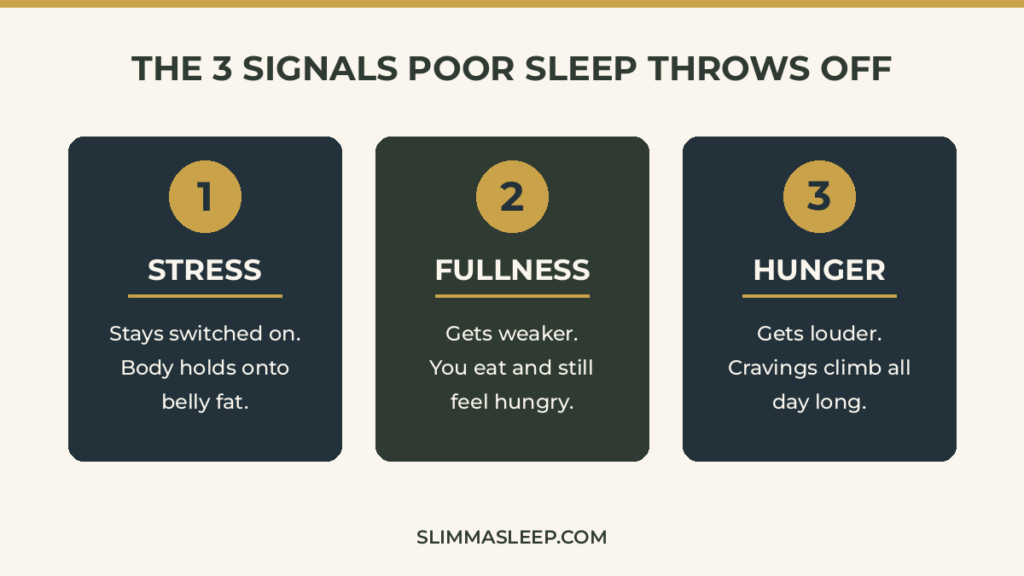
The first tells your body how much stress it’s under. When sleep is short, this signal stays switched on longer than it should — and a body that thinks it’s under constant stress holds onto fat, especially around the middle.
The second tells your brain you’ve had enough to eat. Poor sleep weakens it. So you finish a full meal and still feel unsatisfied an hour later. Not weak willpower — a weakened signal.
The third does the opposite. It tells you you’re hungry. Poor sleep turns it up. More hunger signal, less fullness signal, running at the same time. That’s why a bad night so often leads to a worse day of eating.
You don’t need to memorise the biology tonight. You just need to know the pattern:
👉 Broken sleep flips these signals from working for you to working against you — overnight, silently, before you’ve even had breakfast.
I’ve pulled all three apart in plain language — what they are, how to spot which one is hitting you hardest, and what to do about it — in a free guide. If you want the full breakdown, grab The 3 Hormones Secretly Blocking Your Belly Fat Loss here.
It’s Not About Hours — It’s About Depth
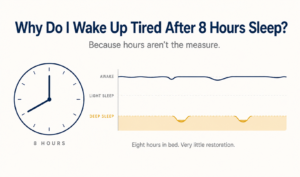
You can spend eight hours in bed and still wake up running on empty.
Because sleep isn’t measured by time alone. It’s measured by how much of that time you spend in the stages that actually count.
There’s light sleep — the shallow kind where you drift and stir. And there’s deep sleep — the stage where your body does its real recovery work. Repair. Hormone reset. The overnight maintenance shift we talked about earlier.
👉 Here’s the problem: deep sleep is the first thing you lose as you age, stress builds, and screens take over your evenings.
You can hit your eight hours and still barely touch the deep stages. On paper you slept fine. In reality your body never got to finish its work.
That’s why two people can both sleep eight hours and feel completely different in the morning. One got the depth. One didn’t.
And it’s why “just sleep more” is incomplete advice. More shallow sleep doesn’t fix the problem. You don’t need more hours in bed — you need more depth inside the hours you already have.
That distinction changes everything about how you approach this. The goal was never just longer sleep.
👉 The goal is deeper sleep.
The Debt You Can’t See Building
This is where poor sleep and weight gain compound each other.
Miss a night of good sleep and you feel it the next day. Tired, foggy, hungrier than usual. That part’s obvious. The link between poor sleep and weight gain is the part that isn’t.
Here’s what’s not obvious: the cost doesn’t reset when you feel normal again.
Poor sleep works like debt. Every bad night adds a little more. And like any debt left unpaid, it compounds — quietly, in the background, until the total is big enough to notice.
👉 The interest gets charged on your waistline.
Here’s how the cycle turns. A poor night throws your hunger signals off. The next day you eat a little more, reach for quicker energy, move a little less. That extra weight makes sleep slightly harder. Which means another poor night. Which throws the signals off again.
Round and round.
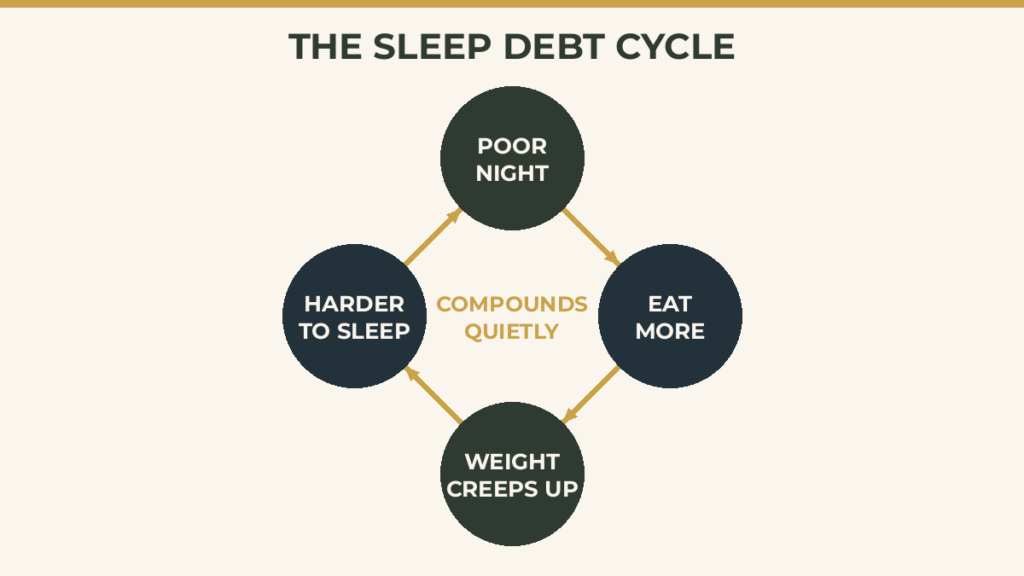
Most people never see the loop because each turn is small. One bad night doesn’t explain the extra pounds. But fifty bad nights across a few months? That adds up to real weight — and a body that feels stuck no matter what you throw at it.
This is the part that makes people give up. They try harder, see nothing, and assume their body is broken or their age is against them.
👉 It’s usually neither. It’s sleep debt that’s been quietly compounding while every effort gets charged interest.
The good news about debt? Once you see it, you can start paying it down.
What Actually Helps (No Lecturing)
None of these fixes require a supplement — they just close the gap between poor sleep and weight gain.
You’ve heard the standard sleep advice a hundred times. I’m not going to insult you with a checklist of “avoid caffeine and dim the lights.”
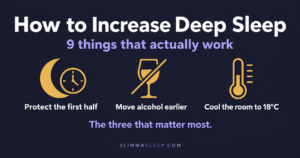
Instead, here’s what actually moves the needle — ranked by how much it matters.
Fix your light exposure first.
Your body decides when to release its sleep signals based on light. Bright morning light early, dim light at night. Most people have this exactly backwards — dark mornings indoors, bright screens at night. Get 10 minutes of daylight early, and cut screen brightness after dark. This one change does more than any supplement.
Protect a consistent sleep window.
Not a perfect bedtime. A consistent one. Your body runs on rhythm, and a wildly different schedule every night keeps it guessing. Same rough window, even on weekends.
Lower the evening stress load.
The stress signal we talked about doesn’t switch off just because you got into bed. If your mind is racing, your body stays in daytime mode. A wind-down routine isn’t soft — it’s how you tell your body the shift can begin.
👉 None of this requires spending a penny. Start here first. Always.
Where supplements fit in
Here’s the honest part.
For some people — especially over 35 — the basics aren’t quite enough on their own. Age has already eaten into their deep sleep, and lifestyle changes only claw back so much.
That’s the gap some supplements try to fill. Not as a replacement for the basics. As support on top of them.
If that’s where you are, it’s worth understanding your options honestly — the good and the bad of each:
👉 If poor sleep is clearly your main issue, our Resurge review breaks down a formula built specifically around deep sleep.
👉 If stubborn belly fat is the bigger frustration, our Ikaria Lean Belly Juice review covers a different root cause worth understanding.
👉 If your metabolism feels like it’s stalled, our HoneyBurn review looks at the enzyme angle most products ignore.
Whatever you do — fix the free stuff first. A supplement can support good sleep habits. It can’t replace them.
The Bottom Line
Here’s what I want you to take away.
If you’ve been working hard and getting nowhere, the problem might not be your effort. It might be what your body can’t finish while you sleep — the quiet mechanics of poor sleep and weight gain working against you.
Poor sleep and weight gain feed each other quietly. Broken sleep throws your hunger and stress signals off. Those signals drive you toward more weight. That weight makes sleep harder. And round it goes — charging interest the whole time.
👉 The way out isn’t more willpower. It’s better recovery.
Fix your light. Protect your sleep window. Wind down properly. Those three things cost nothing and undo more damage than any quick fix ever could.
And if you’re over 35 and the basics aren’t quite closing the gap — that’s when it’s worth looking honestly at what else might help. Not as a shortcut. As support for the work you’re already doing.
You’re not lazy. You’re not broken. You’ve just been fighting with one hand tied behind your back.
Untie it, and the effort you’re already making finally gets to count.
💡 Want to go deeper?
The three signals that poor sleep and weight gain hinge on — the ones quietly driving your cravings and fat storage — are worth understanding properly.
👉 I’ve broken all three down in plain language in a free guide: The 3 Hormones Secretly Blocking Your Belly Fat Loss. Grab it, find out which one is hitting you hardest, and start there.
Start with the easiest one. Move your last drink earlier, or get ten minutes of daylight tomorrow morning. One change, held for a fortnight, tells you more than reading another article. Every little helps.