This post contains affiliate links. If you purchase through our links we may earn a commission at no extra cost to you. Read our Affiliate Disclosure.
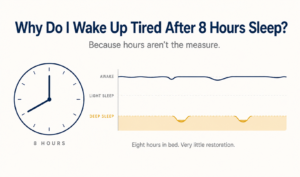
You’re doing eight hours. You’re in bed at a sensible time. And you still wake up feeling like you’ve been hit by something.
That’s usually not a quantity problem. It’s a depth problem — and deep sleep is the stage that decides how you feel in the morning.
👉 The good news is that it responds to what you do. Not completely, and not overnight, but more than most people assume.
What follows is how to increase deep sleep in nine steps, ordered by how much difference they tend to make rather than how often they get repeated. Some of them you’ll have heard before. A few you won’t — and the last one is the opposite of what most sleep advice tells you.
I’ve also included a short section on what barely helps, because a lot of standard advice does very little and you may as well know which bits to skip.
⚠️ One thing first, though. Before the list there’s a reality check worth reading — what’s actually achievable, and what isn’t. It’ll save you chasing a number you were never going to hit.
If you want the background on why you’re waking up tired in the first place, we’ve covered that separately. This post assumes you already know the problem and want the fix.
Let’s get to it.
Table of Contents
First, a Reality Check
Before we get to how to increase deep sleep, two things are worth knowing — because they change what you should be aiming for.
How much deep sleep is normal
Most healthy adults spend 13 to 23% of the night in deep sleep. On a seven or eight-hour night, that’s roughly 60 to 110 minutes.
👉 So if your tracker says 70 minutes and you’ve been panicking about it, you’re squarely in the normal range.
It declines with age, and that’s not a fault
This is the part nobody wants to hear. Deep sleep starts dropping as a percentage of total sleep in your forties, and by your fifties a lower baseline is normal rather than a sign something’s wrong. Some healthy adults over 65 show under 10% and still wake up feeling fine.
⚠️ That matters for expectations. You can meaningfully improve the deep sleep you get. You cannot return to what you had at 25, and chasing that number will only make you anxious — which, as we’ll get to, costs you deep sleep of its own.
What you can actually change
Here’s the encouraging part.
The rate of decline varies enormously between individuals, and it isn’t fixed. Regular exercise is the single strongest predictor of maintained deep sleep in older adults, and consistent sleep timing, avoiding alcohol and managing stress are the other protective factors.
👉 Which means the people holding onto the most deep sleep at 60 aren’t genetically lucky. They’re the ones who’ve slept on a regular schedule and trained consistently for decades.
One thing about trackers
If you’re reading this because your ring or watch shows a low number, treat it as a rough guide rather than a measurement.
Consumer devices infer sleep stages from movement and heart rate, and they only moderately agree with proper lab equipment. Judge weekly trends, not individual nights.
👉 And if you’re consistently waking up feeling rested, the number matters less than how you feel. That’s the actual outcome you’re after.
Now — here’s what works, best first.
1. Protect the First Half of Your Night
This is the most useful thing on the page, and everything else is downstream of it.
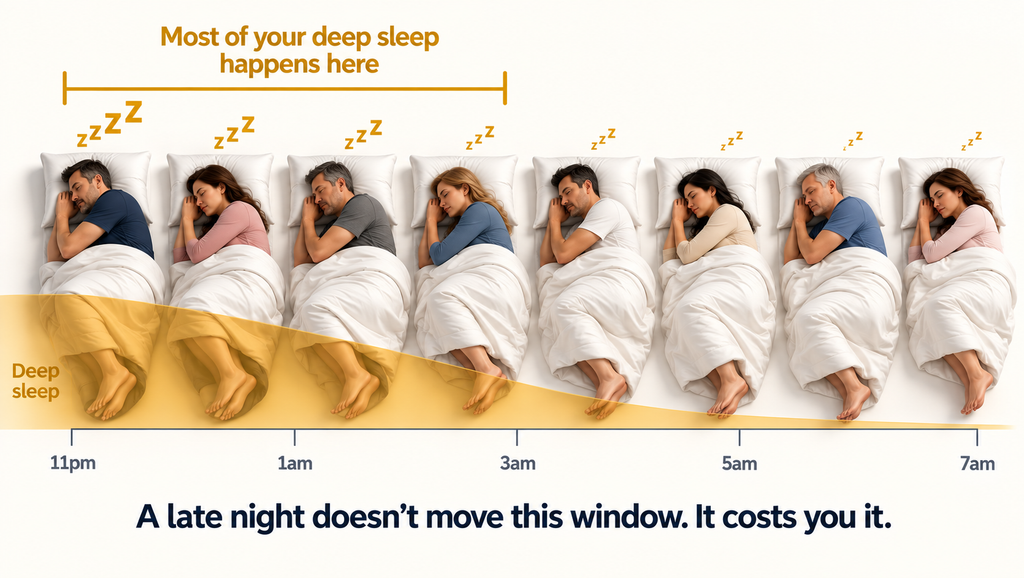
If you want to know how to increase deep sleep, start here — it clusters in the first third of the night. Your early cycles carry long stretches of it. As the night goes on, those stretches shrink and more of your time shifts into REM instead.
👉 Which means what happens between 10pm and 1am matters far more than what happens between 4am and 7am.
What this changes practically
Most people trying to improve their sleep focus on total hours. They go to bed at the same time, get disturbed at 11pm, and assume they’ll make it up by sleeping later in the morning.
You can’t. The extra hour at the end of the night is mostly light sleep and REM. The deep sleep opportunity has passed.
A real example
Say you normally get to bed at 10:30. One evening you stay up watching something until midnight, then sleep until 8am instead of your usual 6:30.
Same eight hours on the clock. But you’ve pushed your entire night ninety minutes later and lost a chunk of your deepest cycles to being awake. You wake up feeling like you barely slept, despite the numbers looking identical.
👉 That’s why a late night hits harder than it should, even when you make up the hours.
What to do
Treat the first three hours after you fall asleep as protected time.
That means the things that disrupt them — a late drink, a heavy meal, an argument, a phone in bed — cost you disproportionately. Getting those out of that window does more than any other change on this list.
⚠️ And if you have to choose between going to bed at your usual time on less sleep, or going late and sleeping in, go to bed on time. The early cycles are worth more than the late ones.
2. Move Alcohol Earlier — or Skip It
For most people over 35 who drink in the evening, this is the single biggest lever available.
It catches people out because a drink genuinely does help you fall asleep faster. That’s why it feels like it’s helping.
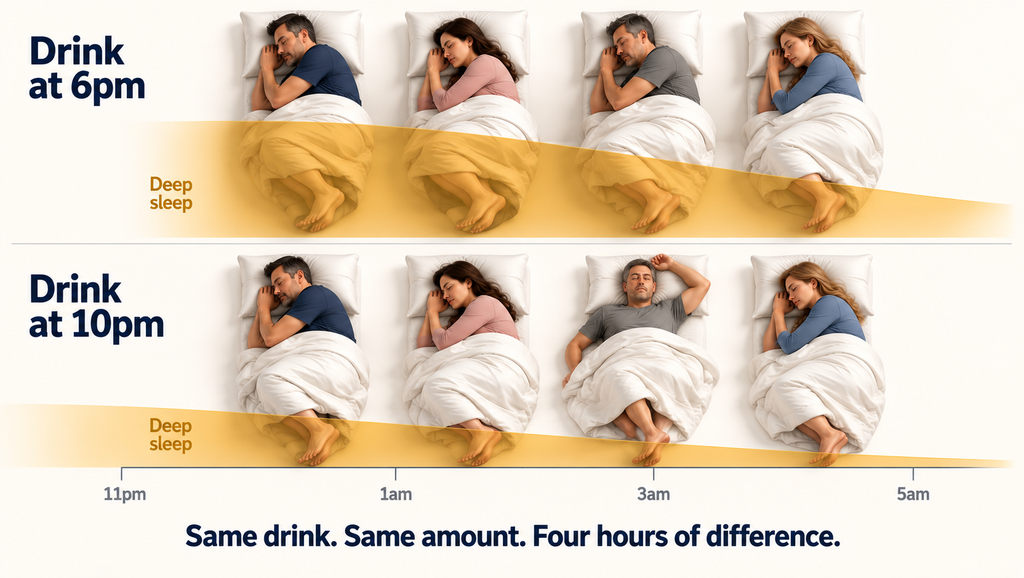
👉 But alcohol suppresses deep sleep in the first half of the night — exactly when you’d otherwise be getting most of it. Then as your body metabolises it, the second half becomes fragmented and shallow.
You fall asleep quickly, sleep badly, and wake up flattened. Which is precisely what happened.
A real example
Two glasses of wine with dinner at 7pm, in bed by 10:30. Feels reasonable. You drop off easily and don’t remember waking.
But your body is still processing alcohol through the exact window your deepest cycles should be running. Then around 3am, as the last of it clears, you surface — maybe fully, maybe just enough to shift into lighter sleep for the rest of the night.
⚠️ The tell is waking between 2 and 4am on nights you’ve had a drink, and not on nights you haven’t. Most people put that down to age or stress. It’s usually the wine.
What to do
You don’t have to quit. Move it earlier.
A drink at 6pm has largely cleared by the time you go to bed. The same drink at 10pm sits directly on top of your deep sleep window.
👉 Try one week with nothing after 7pm. It’s the fastest experiment on this list, and the difference is usually obvious by the third or fourth morning.
And if you’re drinking most evenings rather than occasionally, that’s worth looking at separately — the cumulative effect on sleep quality is larger than any single night suggests.
3. Get Your Bedroom Genuinely Cold
Your core temperature has to drop for deep sleep to happen. That’s not a comfort preference — it’s part of the mechanism.
A warm bedroom physically interferes with it. Your body is trying to shed heat, the room won’t let it, and the deep stages don’t arrive properly.
👉 Most bedrooms are too warm, and almost nobody suspects it.
What “cold enough” actually means
Cooler than feels immediately comfortable when you get into bed.
That’s the useful test. If the room feels pleasant and cosy as you climb in, it’s probably too warm for what your body needs three hours later. You want it slightly cool at bedtime, with enough bedding to stay comfortable.
If you want a number: around 18°C, or 65°F. Most guidance lands between 16 and 19°C, and 18 sits comfortably in the middle. Above roughly 24°C, sleep quality starts to degrade for most people.
👉 That said, don’t obsess over the thermostat. The test above — slightly cool when you get in — gets you close enough without measuring anything.
A real example
Winter is where this goes wrong most often.
Heating on through the evening, bedroom door closed, thick duvet. You get into a warm bed feeling lovely, and you sleep badly without ever connecting the two. Then in summer you sleep worse again because the room’s genuinely hot — so you conclude you just sleep badly year-round.
⚠️ The other common one: a partner who runs cold, so the room is set for them. One of you sleeps well and the other doesn’t, and neither of you works out why.
What to do
Turn the bedroom heating off or right down well before bed, so the room has cooled by the time you’re in it. Crack a window if you can.
👉 A warm shower an hour before bed also works, counterintuitively — the subsequent drop in body temperature as you cool down helps trigger the transition.
Separate duvets are worth considering if you and your partner disagree on temperature. It sounds unromantic and it solves the problem completely.
4. Keep One Consistent Sleep Window
Your body runs on rhythm. It starts preparing for sleep before you get into bed — body temperature falling, sleep hormones rising — but only if it knows roughly when bed is coming.
Go to sleep at wildly different times and it never settles into a pattern. The preparation doesn’t happen on schedule, so your early cycles take longer to get going and you lose deep sleep off the front of the night.
👉 Not a perfect bedtime. A consistent one.
A real example
Monday to Friday you’re in bed by 10:30 because work starts early. Friday and Saturday you’re up until 1am, then sleep until 9.
That’s a four-hour swing, twice a week, every week. Your body spends Monday trying to work out what happened — which is why Sunday nights are hard to fall asleep and Monday mornings feel like jet lag.
⚠️ Because functionally, that’s what it is. You’ve flown two time zones west on Friday and back again on Sunday.
What to do
Pick a window rather than a fixed time. Something like 10:30 to 11:30 — anywhere in there counts as on schedule.
👉 The wake time matters more than the bedtime. Getting up at roughly the same hour every day, including weekends, anchors the whole rhythm. A late night occasionally is survivable. A late morning undoes the pattern.
If you want a lie-in at the weekend, cap it at an hour past your usual wake time. That’s enough to feel like a break without shifting your clock.
⚠️ And if you work shifts, none of this applies cleanly — that’s a genuinely harder problem, and worth raising with a doctor if your sleep is suffering badly.
4. Keep One Consistent Sleep Window
Your body runs on rhythm. It starts preparing for sleep before you get into bed — body temperature falling, sleep hormones rising — but only if it knows roughly when bed is coming.
Go to sleep at wildly different times and it never settles into a pattern. The preparation doesn’t happen on schedule, so your early cycles take longer to get going and you lose deep sleep off the front of the night.
👉 Not a perfect bedtime. A consistent one.
A real example
Monday to Friday you’re in bed by 10:30 because work starts early. Friday and Saturday you’re up until 1am, then sleep until 9.
That’s a four-hour swing, twice a week, every week. Your body spends Monday trying to work out what happened — which is why Sunday nights are hard to fall asleep and Monday mornings feel like jet lag.
⚠️ Because functionally, that’s what it is. You’ve flown two time zones west on Friday and back again on Sunday.
What to do
Pick a window rather than a fixed time. Something like 10:30 to 11:30 — anywhere in there counts as on schedule.
👉 The wake time matters more than the bedtime. Getting up at roughly the same hour every day, including weekends, anchors the whole rhythm. A late night occasionally is survivable. A late morning undoes the pattern.
If you want a lie-in at the weekend, cap it at an hour past your usual wake time. That’s enough to feel like a break without shifting your clock.
⚠️ And if you work shifts, none of this applies cleanly — that’s a genuinely harder problem, and worth raising with a doctor if your sleep is suffering badly.
5. Get Daylight Early
This one costs nothing, takes ten minutes, and most people have it completely backwards.
Your body decides when to release sleep hormones based on light. Bright light early in the day sets the clock. Dim light in the evening lets it wind down on schedule.
👉 What most people actually do is the opposite — dark mornings indoors, then bright screens and overhead lights at night.
Why it matters for deep sleep specifically
If your internal clock is running late, your body doesn’t start preparing for sleep until midnight even though you’re in bed at 10:30.
So you lie there, eventually drift off around 12, and your deep sleep window gets pushed back into hours you don’t have. You wake at 6:30 having missed a chunk of it entirely.
Morning light pulls that whole sequence earlier, which means the preparation is done by the time you get into bed.
A real example
Winter is when this breaks for most people in northern countries.
You leave the house in the dark, sit under office lighting all day, and come home in the dark. Your body genuinely doesn’t receive a clear morning signal for months at a time. Then you wonder why your sleep gets worse from November onward.
⚠️ Office lighting is far dimmer than daylight, even on an overcast day. Sitting by a window is not the same as going outside.
What to do
Ten minutes outside within an hour of waking. Not through a window — outside, even if it’s grey.
👉 Walking to a shop, standing in the garden with coffee, taking the bins out slowly. The activity doesn’t matter, the light does.
Then in the evening, dim what you can. Lamps rather than overheads, screen brightness down after dark.
6. Train — But Not Too Late
Exercise is the single strongest predictor of maintained deep sleep as you age. A meta-analysis found it increases both the duration and intensity of slow-wave sleep across all age groups.
👉 That’s a bigger claim than anything else on this list has behind it.
Why it works
Physical exertion increases your body’s need for repair, and deep sleep is when that repair happens. Give your body a genuine reason to restore itself and it responds by spending longer in the stage that does it.
Resistance training and vigorous aerobic work both count. You don’t need either in large quantities.
A real example
Two people, both 48, both sleeping seven hours. One walks to the car and back. The other does two half-hour strength sessions a week and a couple of walks.
Same hours in bed. But the second person’s body has an actual repair job to do overnight, and their deep sleep reflects that.
👉 This is also why people who’ve trained consistently for decades hold onto far more deep sleep into their sixties than those who haven’t. It isn’t luck.
The timing caveat
Hard exercise raises your core temperature and your heart rate, and both need to come down before deep sleep can happen properly.
⚠️ A heavy session at 9pm can genuinely cost you. You’ll fall asleep fine — you’re tired — but the early cycles are shallower than they should be while your body is still cooling down.
Finish anything intense at least two or three hours before bed. Morning or early evening is ideal.
What to do
Two or three sessions a week. Bodyweight, bands, dumbbells, a brisk walk with hills — the specific method matters far less than doing it at all.
👉 You’re not training to exhaust yourself into sleep. You’re giving your body something to recover from.
7. Cut Caffeine Earlier Than You Think
This one gets dismissed because people judge it by the wrong test.
“Caffeine doesn’t affect me — I can have a coffee at 8pm and fall asleep fine.”
👉 Probably true. And not the point.
Falling asleep isn’t the issue
Caffeine blocks the chemical that builds up through the day and makes you feel sleepy. If you’re tired enough, you’ll drop off anyway.
But the sleep you get is shallower. Caffeine still in your system reduces the depth of your early cycles — the ones carrying most of your deep sleep.
⚠️ That’s why it’s so easy to miss. You slept seven hours, you didn’t lie awake, and nothing felt wrong. The quality was just worse, and you’ve no way of noticing that from the inside.
The half-life problem
Caffeine takes roughly five to six hours to clear half of what you consumed. Half.
So a coffee at 2pm means a meaningful amount is still circulating at 10pm. A coffee at 4pm is still working at midnight.
A real example
Someone drinks two coffees in the morning and one after lunch at 2:30. That feels sensible — nothing in the evening.
But that 2:30 coffee is at half strength by 8pm and still present when the deep sleep window opens. Multiply by every working day and it’s a permanent low-level tax on sleep quality.
👉 Sensitivity varies a lot. Some people clear it faster, some much slower, and it tends to slow with age.
What to do
Set a cutoff at midday or early afternoon and hold it for two weeks.
👉 That’s long enough to notice a difference and short enough to be worth trying. If nothing changes, you’re one of the fast metabolisers and you can relax about it.
Watch green tea, cola and dark chocolate too — smaller amounts, same mechanism.
8. Give Your Brain Somewhere to Put Tomorrow
If your mind starts racing the moment your head hits the pillow, you already know this one.
You’re exhausted. You’ve been yawning since nine. Then you lie down and your brain produces a detailed inventory of everything unresolved in your life.
👉 That’s not a character flaw. It’s the first quiet moment your brain has had all day, and it uses it.
Why it costs you deep sleep
A racing mind keeps your body in daytime mode. Stress hormones stay elevated, your heart rate doesn’t settle, and the transition into deep sleep doesn’t happen cleanly.
Even when you do fall asleep, those early cycles run shallower than they should.
A real example
You get into bed at 10:30 genuinely tired. Then you remember you haven’t replied to something, and whether you handled a conversation badly, and that you need to book the car in.
None of it is urgent. None of it can be done at 10:30pm. But your brain keeps cycling through because it has nowhere else to put any of it.
You finally drop off around 11:45. An hour and a quarter of your best sleep window, spent awake.
What to do
Write tomorrow down before you get into bed. Not a journal — a list.
👉 It sounds too simple to work, and it works because it gives those thoughts a destination other than your pillow. Your brain stops rehearsing them once it’s confident they’re recorded somewhere.
Five minutes, on paper, while you’re still downstairs.
⚠️ And if you wake in the night with something on your mind, keep a notepad by the bed rather than reaching for your phone. Write it down, put it away, go back to sleep.
9. Stop Chasing the Number
This is the one nobody else will tell you, and for some people reading this, it’s the most important item on the list.
If you’re wearing a ring or a watch and checking your deep sleep score every morning, that habit may be costing you more than it’s giving you.
Why the number is less reliable than it looks
Consumer trackers infer sleep stages from movement and heart rate. They only moderately agree with proper lab equipment.
👉 So the 43 minutes it reported last night might have been 60. Or 30. You genuinely don’t know.
Why checking it makes things worse
Here’s the loop.
You wake up. Before you’ve properly opened your eyes, you check your score. It’s low. You spend the day expecting to feel tired, and you do. That evening you get into bed thinking about whether tonight’s number will be better.
⚠️ Now you’re anxious about sleep, at bedtime, which is exactly the state that prevents deep sleep.
There’s a name for this — orthosomnia. Sleep anxiety caused by sleep tracking. And it’s common enough in people chasing better numbers that it’s worth naming plainly.
A real example
Someone buys a ring to improve their sleep. Within a month they’re sleeping worse, because every night has become a test they might fail.
They didn’t have a sleep problem before. They have one now, and the device created it.
What to do
Keep the tracker if you find it useful — but change how you read it.
👉 Look at weekly averages, not individual nights. Check it once a week, not every morning. And judge by how you feel during the day, which is the actual outcome you care about.
If you find yourself anxious about the number, take the thing off for a fortnight. Most people sleep better without it.
What Barely Helps
Not everything sold as a way to increase deep sleep does much. Worth being straight about the advice you’ll find everywhere that does very little.
Blue light glasses
The evidence is thin. Dimming your lights and dropping screen brightness costs nothing and does more. If the glasses help you build an evening routine, fine — but they’re not doing much on their own.
Most sleep supplements
Melatonin can help you fall asleep faster and shift a disrupted schedule. It does considerably less for the depth of the sleep that follows.
👉 And nothing you take will outrun a warm bedroom, a 10pm glass of wine and an inconsistent bedtime. Fix those first. They’re free.
More hours in bed
If quality is your problem, extending the night doesn’t solve it. Going to bed at 9pm to get ten hours of shallow sleep mostly produces ten hours of shallow sleep.
⚠️ You need more depth inside the hours you already have, not more hours.
Weighted blankets, white noise, elaborate routines
Some people genuinely find these useful, and if they work for you, keep them. But they’re comfort measures rather than mechanisms. None of them address why deep sleep is short in the first place.
Where supplements do fit
Honestly? After the nine items above, not before them.
That said — if you’ve held all nine consistently for a couple of months and you’re still short, age-related decline may be the limiting factor rather than anything you’re doing wrong.
👉 If that’s where you are, our Resurge review looks at a formula built specifically around deep sleep and growth hormone — including where its marketing overreaches and who it genuinely suits.
Not as a shortcut. As support for work you’re already doing properly.
The Bottom Line
That’s how to increase deep sleep in nine steps — and you don’t need all of them.
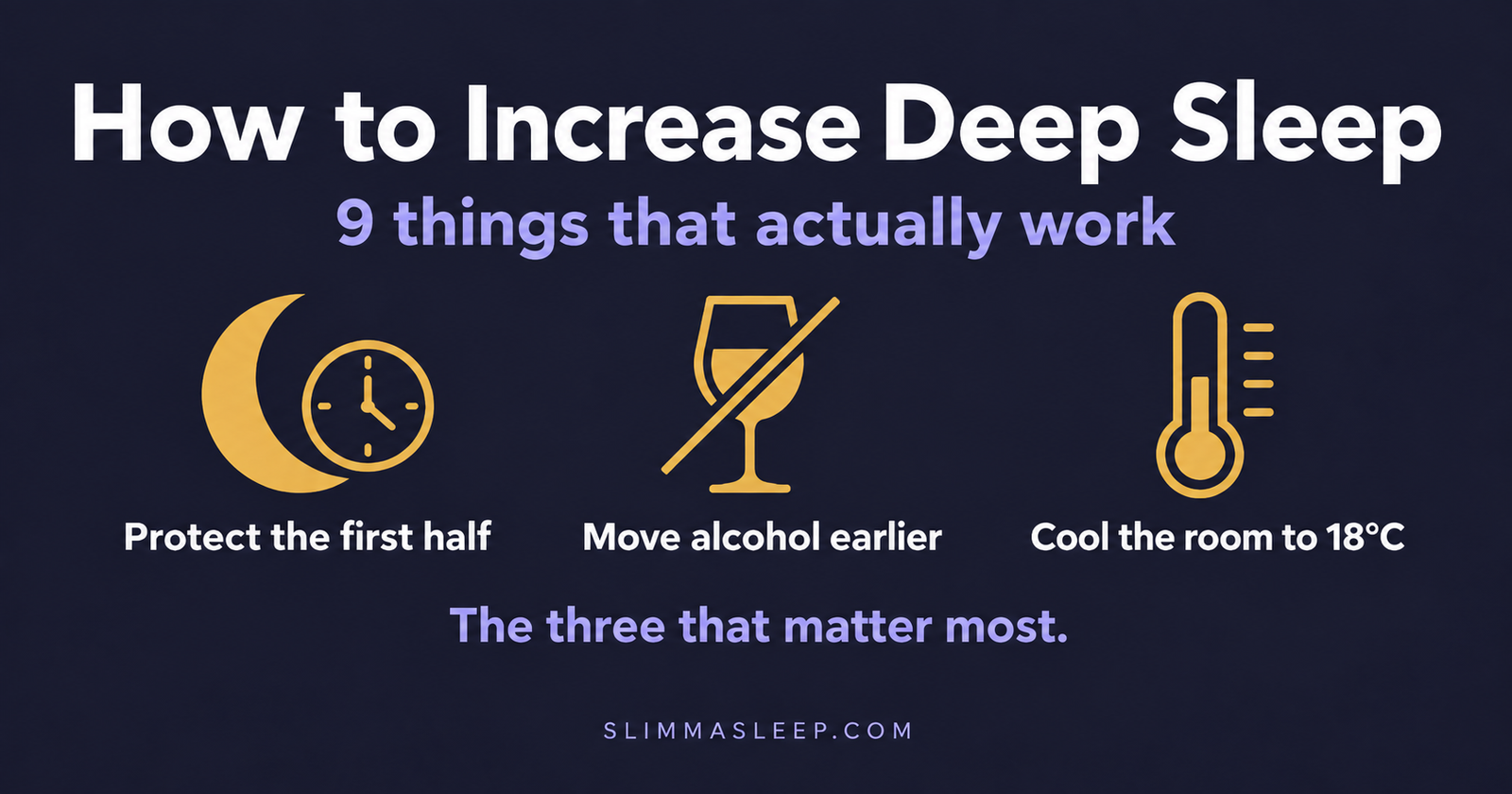
If you only take three, take these. Protect the first half of your night — that’s where your deep sleep lives. Move alcohol earlier, because for most people over 35 it’s the single biggest thief. And get the bedroom genuinely cold, around 18°C, because your body physically can’t reach deep sleep while it’s fighting to shed heat.
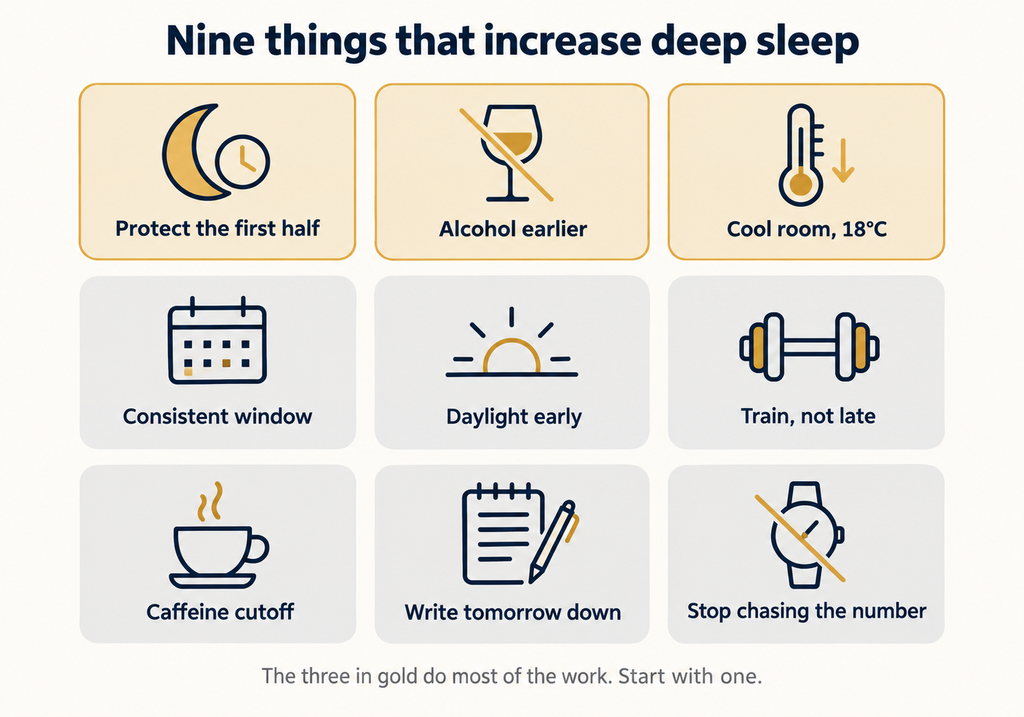
👉 Those three cost nothing and address the mechanism directly.
Set your expectations honestly
Deep sleep declines with age. That’s normal, it isn’t a failure, and no amount of optimising returns you to what you had at 25.
But the rate of decline varies enormously between people, and knowing how to increase deep sleep genuinely shifts it. The ones holding onto the most at 60 are the ones who trained consistently and kept a regular schedule for years — not the ones who found a trick.
⚠️ And if you’ve done all of this properly for a couple of months and still wake up exhausted every day, that’s worth a conversation with your doctor rather than another adjustment. Sleep apnea in particular is common, easily missed, and produces exactly this picture.
We’ve covered what that looks like in our post on waking up tired after a full night.
One last thing
Don’t try all nine at once. You’ll last four days and abandon the lot.
Pick one. Hold it for two weeks. See whether your mornings feel different — not whether the number changed, whether you feel different. Then add another.
💡 Want to understand why this matters beyond feeling tired?
Poor deep sleep shifts the signals that control hunger, stress and how your body stores fat — and most people have no idea which of those is affecting them most.
👉 I’ve broken all three down in plain language in a free guide: The 3 Hormones Secretly Blocking Your Belly Fat Loss.
Start with the cold bedroom tonight. It takes thirty seconds and you’ll know within a week. Every little helps.