You didn’t change anything.
Same food, roughly the same routine, same effort you’ve always put in. But at some point over the last year or two, your middle got thicker — and it hasn’t gone anywhere since.
The rest of you looks much the same. Arms, legs, face. It’s just the belly, and it feels firm rather than soft, like it’s pushing outward from somewhere deeper than skin level.
👉 If that’s the pattern, stress may be the reason — and the way you’re trying to fix it might be making it worse.
Cortisol is your body’s stress hormone. When it stays elevated for months rather than minutes, it changes where your body stores fat. Not how much, necessarily. Where. And it sends it to your midsection specifically, for reasons that come down to a real physical difference between the fat around your organs and the fat everywhere else.
Here’s the part most advice gets wrong. The instinct is to cut harder — fewer calories, more cardio, push through it. But restriction is itself a stressor, and past a certain point it raises the very hormone driving the problem.
That’s why this doesn’t respond to the usual approach. You’re not short on discipline. You’re using a tool that works against this particular mechanism.
This post covers what cortisol belly actually is, why it targets your stomach rather than spreading out, how to tell whether it’s your issue or something else, and how to reduce cortisol belly fat without the punishing approach that keeps backfiring.
It also covers the point where this stops being a lifestyle question and becomes a medical one — because for a small number of people reading this, that’s the useful answer.
Let’s start with what’s actually going on.
This post contains affiliate links. If you purchase through our links we may earn a commission at no extra cost to you. Read our Affiliate Disclosure.
What Cortisol Belly Actually Is
Cortisol is your body’s main stress hormone. It isn’t the villain it gets painted as — you need it. It wakes you up in the morning, it manages inflammation, and it mobilises energy when you genuinely need it.
The problem isn’t cortisol. It’s cortisol that never switches off.
What a normal cortisol response looks like
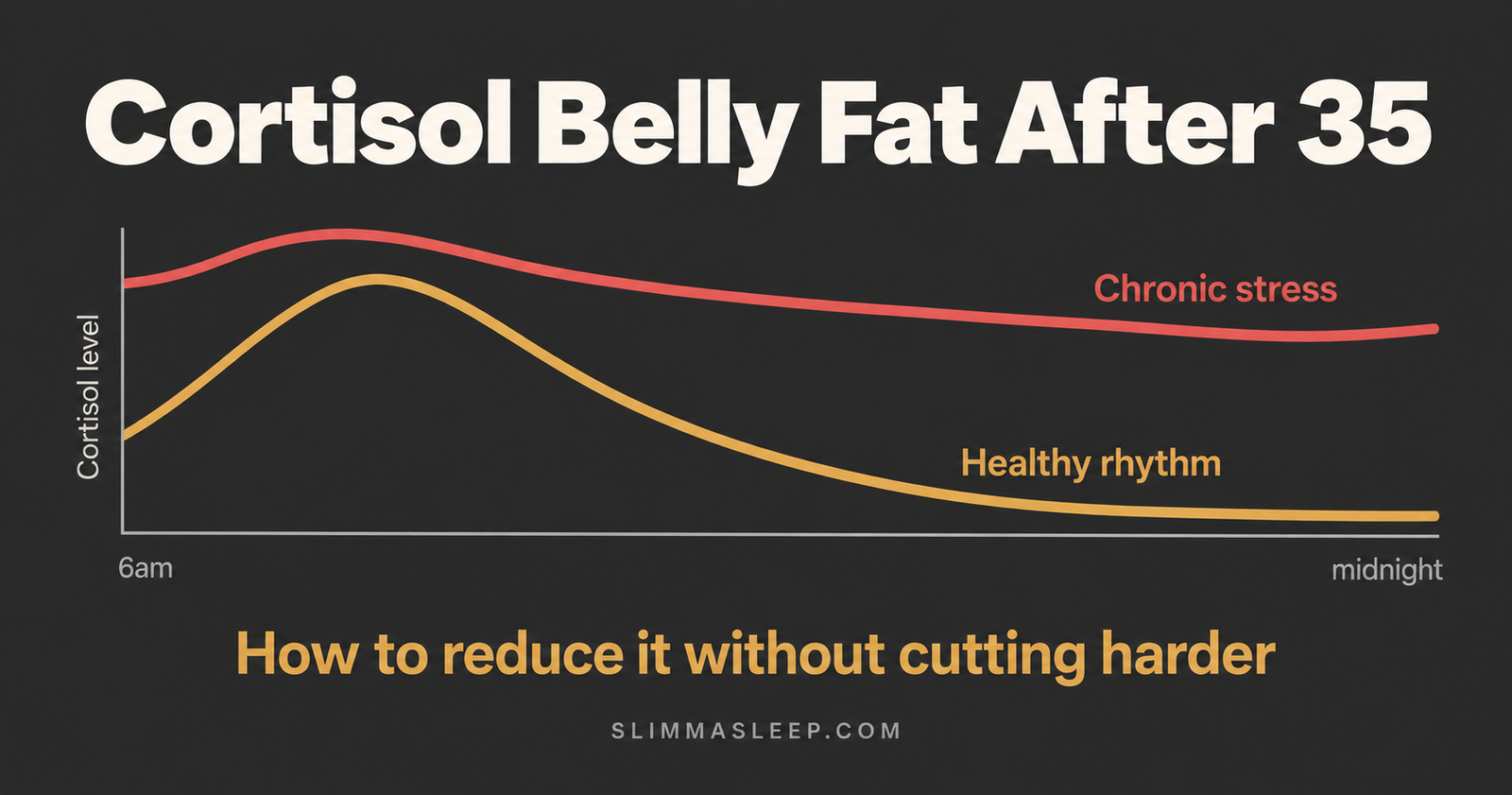
Something stressful happens. Cortisol rises. It releases stored energy into your bloodstream so you can deal with whatever it is. Then the situation passes, cortisol drops back down, and your body returns to normal.
👉 That’s the system working correctly. A spike, then a return to baseline.
What chronic elevation looks like
Now picture stress that doesn’t pass. Work pressure that runs for months. Caring responsibilities. Money worries. Poor sleep every night. A relationship that’s hard work.
Your body responds the same way it always does — cortisol rises. But there’s no resolution, so it never comes back down properly. It stays elevated, quietly, for weeks or years at a time.
That’s the state your body isn’t designed for. And it’s where cortisol belly comes from.
So what is cortisol belly?
It’s fat that accumulates specifically around your midsection as a result of sustained high cortisol.
It tends to look and feel different from ordinary weight gain. Rather than soft fat you can pinch, it often sits firmer and deeper, pushing outward from behind the abdominal wall. The rest of your body might look relatively unchanged while your middle has visibly thickened.
👉 That combination — a firm, rounded belly on an otherwise fairly normal frame — is what people mean when they talk about cortisol belly.
The obvious question is why. Why does stress put fat on your stomach specifically, rather than spreading it around like everything else?
That’s where it gets interesting.
Why the Belly Specifically?
Here’s the question almost nobody answers properly. If cortisol releases stored energy, why does the fat land on your stomach rather than spreading evenly?
The answer comes down to a genuine physical difference between the fat around your organs and the fat elsewhere on your body.
Visceral fat has more cortisol receptors
Every fat cell has receptors that respond to cortisol. But they aren’t distributed evenly.
👉 Abdominal fat tissue has more cells per unit of mass, higher blood flow, and more glucocorticoid receptors than the fat under your skin elsewhere.
More receptors means a stronger response. When cortisol circulates, the fat around your organs reacts far more than the fat on your arms or legs. Same hormone, same bloodstream — but the belly is simply listening harder.
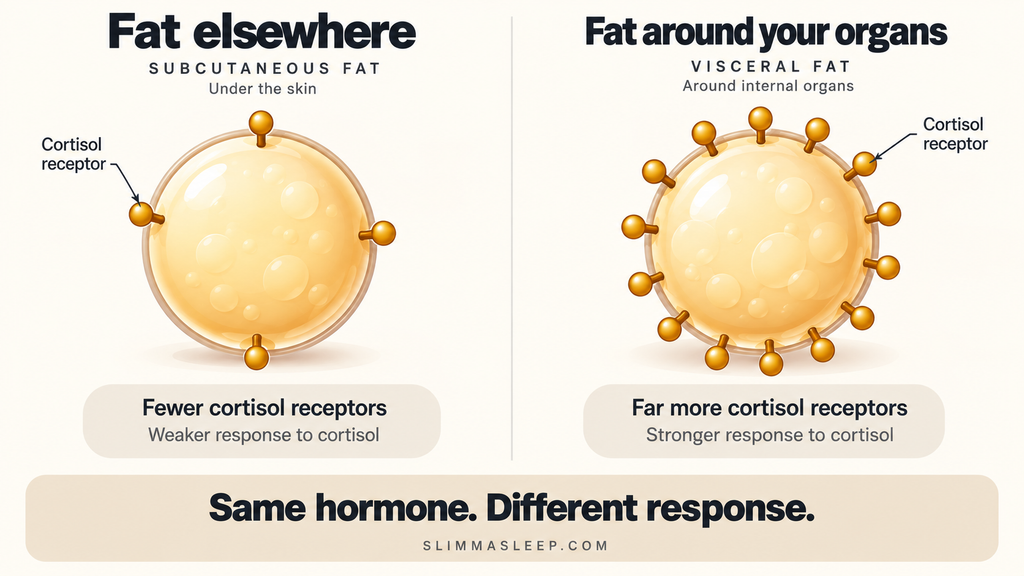
That’s why stress-driven weight gain has a signature shape rather than being spread around.
There’s a second mechanism, and it’s the one that explains the puzzle
Here’s something that confused researchers for years.
People with clear cortisol belly often have normal blood cortisol levels when tested. If cortisol were the cause, you’d expect it to show up in a blood test. Frequently it doesn’t.
The explanation is that your fat tissue makes its own.
An enzyme called 11β-HSD1, present in fat tissue, converts inactive cortisone into active cortisol locally — right inside the fat cells. Your bloodstream can look normal while the tissue around your organs is generating its own supply.
👉 That’s why “my cortisol came back normal” doesn’t necessarily rule this out. The action is happening at tissue level, not in your blood.
What this means practically
Two things follow from all of this.
First, cortisol belly isn’t a willpower problem or a calorie problem. It’s a distribution problem — your body deciding where to put fat based on a hormonal signal rather than what you ate.
Second, you can’t target it with exercises. No amount of core work changes where your body chooses to store fat. That decision is made hormonally, which means the fix has to be hormonal too.
👉 Which is the whole reason “how to reduce cortisol belly fat” is a different question from “how to lose weight.”
Signs It’s Cortisol Rather Than Something Else
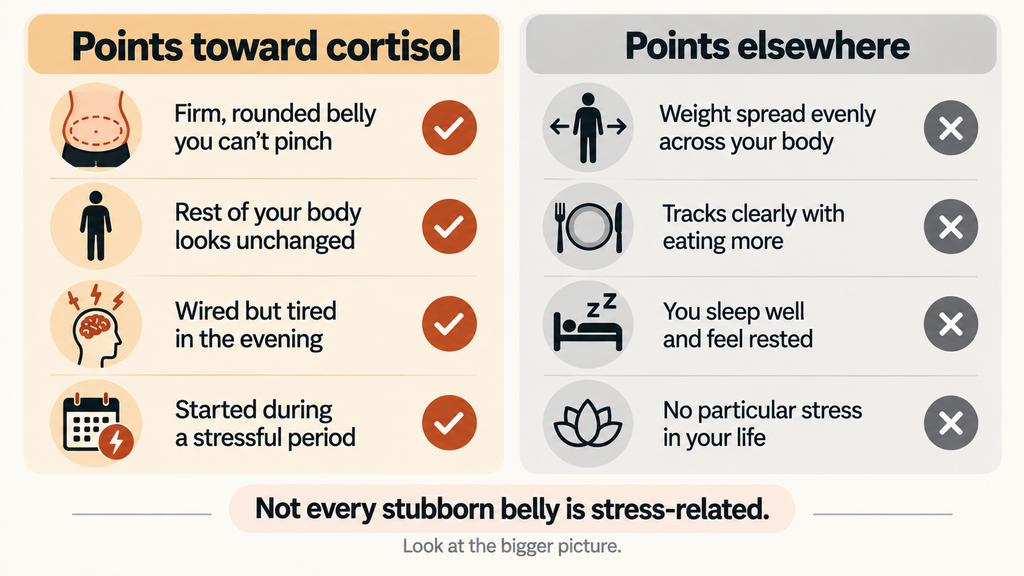
Belly fat has several possible causes, and cortisol is only one of them. Here’s how to tell whether stress is the likely driver in your case.
Read these honestly:
👉 The weight appeared around your middle without your eating or exercise changing much
👉 Your belly feels firm and rounded rather than soft and pinchable
👉 The rest of you looks relatively unchanged — arms, legs and face much the same
👉 You feel wired but exhausted in the evening, too tired to do anything but unable to switch off
👉 Stress reliably triggers cravings, usually for sugar or something salty and carb-heavy
👉 You sleep badly, or sleep enough hours and still wake unrefreshed
👉 The weight gain lines up with a genuinely stressful period — a job change, a bereavement, a caring responsibility, financial pressure
👉 Cutting calories harder hasn’t worked, and may have made things worse
If most of those land, cortisol is a reasonable suspect.
The firmness test
Of all the signs above, this is the one worth paying attention to.
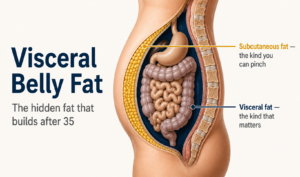
Subcutaneous fat — the ordinary kind — sits under your skin and you can grab it between your fingers. Visceral fat sits behind the abdominal wall, so you can’t pinch it. It pushes outward from inside.
👉 A belly that feels firm and full rather than soft usually means more of it is visceral. And visceral fat is what cortisol drives.
We’ve covered the difference between the two types in more detail in our post on visceral belly fat, if you want the fuller picture.
What points away from cortisol
Worth being even-handed here, because not every stubborn belly is stress-related.
If your weight gain is spread fairly evenly across your body, if it tracks clearly with eating more than you used to, or if you genuinely sleep well and don’t feel particularly stressed — something else is more likely the driver.
👉 In that case, our post on why a calorie deficit sometimes stops working covers the other common explanations.
The Loop Nobody Warns You About
Here’s the part that catches people out, and it explains why the obvious response to cortisol belly often makes it worse.
Dieting is a stressor.
Not emotionally — physically. When you cut calories significantly, your body registers a shortage of incoming energy. That’s a stress signal, and it prompts exactly the hormonal response you’d expect.
👉 Restriction raises cortisol. Which is the hormone driving the fat storage you’re trying to reverse.
How the loop turns
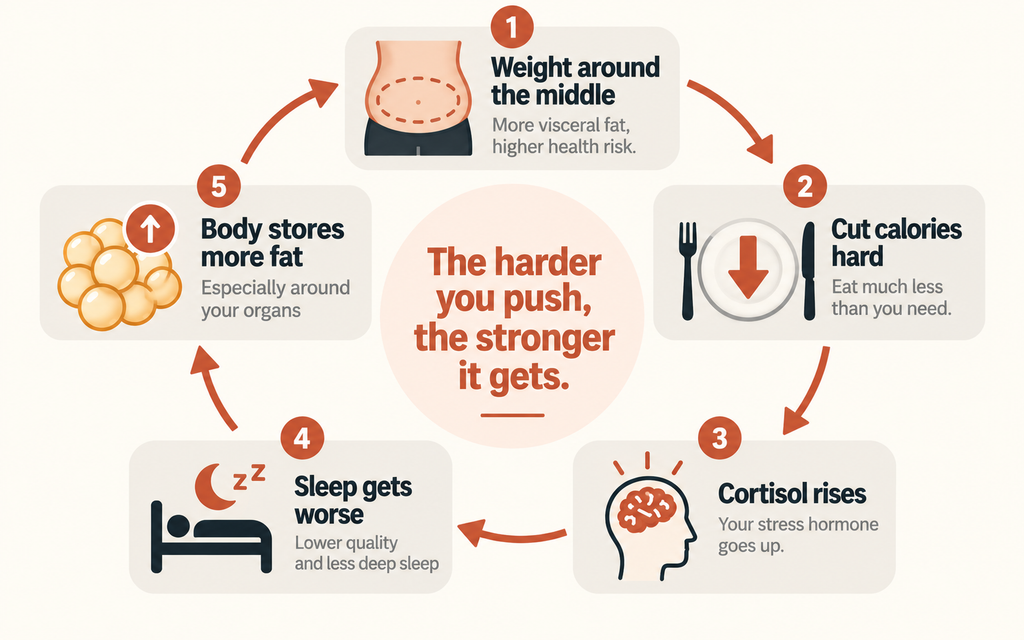
Picture how this usually plays out.
You notice weight around your middle. You respond by cutting hard — fewer calories, more cardio, maybe skipping meals. Reasonable response, and it’s what most advice recommends.
But the aggressive deficit raises cortisol. Your sleep gets worse because you’re underfed and your body is running on stress hormones. Poor sleep raises cortisol further. Your cravings intensify, your energy drops, and you move less without noticing.
Meanwhile the elevated cortisol keeps signalling your body to store fat in exactly the place you’re trying to lose it.
👉 You’re working harder, feeling worse, and feeding the mechanism causing the problem.
Why “just try harder” is the wrong instruction
This is what makes cortisol belly genuinely different from ordinary weight gain.
With most fat loss, more effort produces more result, at least for a while. With cortisol-driven fat, past a certain point more effort produces more cortisol — and the returns don’t just diminish, they can reverse.
It’s the one situation where doing less of the aggressive stuff works better than doing more.
⚠️ That’s a hard thing to accept when you’ve been told your whole life that weight loss is about discipline. But the biology here doesn’t reward pushing harder.
What this means for how you approach it
If cortisol is your driver, the fix isn’t a harder version of what you’ve been doing. It’s a calmer version.
A moderate deficit instead of an aggressive one. Strength work instead of hours of cardio. Genuine recovery instead of pushing through. Sleep treated as part of the plan rather than an afterthought.
👉 None of that sounds like a weight loss strategy. That’s precisely why it works for this particular problem.
Why This Gets Worse After 35
Cortisol belly can happen at any age. But it becomes noticeably more common from the mid-thirties onward, and there are a few reasons that stack up.
Your stress recovery slows down
The cortisol response itself doesn’t change much with age. What changes is how quickly you return to baseline afterwards.
At 25, a stressful week and a couple of bad nights are absorbed fairly quickly. At 45, the same stress load sits with you longer. Cortisol stays elevated for more hours of the day, which means more total exposure even though nothing about your life got objectively harder.
👉 Same stress, longer tail.
Your deep sleep has already declined
This is the compounding factor, and it’s the one your body can least afford.
Deep sleep — the genuinely restorative stage — declines steadily from your thirties. That matters here because deep sleep is when cortisol should be at its lowest and your body does its recovery work.
Less deep sleep means less overnight cortisol clearance. And elevated cortisol then makes it harder to reach deep sleep the following night.
⚠️ That’s a second loop running alongside the dieting one. Two self-reinforcing cycles, both feeding the same problem.
If you’re sleeping the hours but waking unrefreshed, we’ve explained what’s actually happening there — and it’s directly relevant to this.
The stress itself usually increases
The unglamorous reason, and often the biggest one.
Your mid-thirties onward tends to be when life gets heaviest. More career responsibility. Children, or ageing parents, or both. Mortgages. Less discretionary time and fewer easy opportunities to decompress.
👉 The stress load rises at precisely the point your capacity to recover from it falls.
Less muscle to work with
One more factor worth naming. You lose muscle gradually from your thirties, which lowers your resting metabolic rate.
That doesn’t cause cortisol belly directly, but it narrows your margin. The same habits now produce a slightly different outcome, and it’s easy to blame yourself for something that’s partly just arithmetic.
We covered that properly in our post on what changes after 35.
How to Reduce Cortisol Belly Fat
Here’s what actually works, ordered by how much difference it tends to make.
⚠️ None of it is dramatic. That’s the point — dramatic is what raises cortisol in the first place.
Fix your sleep before anything else
This is the highest-leverage change available, and it isn’t close.
Cortisol should fall to its lowest point overnight. If your sleep is short or shallow, that clearance doesn’t happen properly, and you start the next day already elevated. Do that for months and you’ve got chronic exposure regardless of what else you’re doing right.
👉 Protect the first half of your night — that’s where most of your deep sleep happens. Move alcohol earlier, keep your bedtime roughly consistent, and cool the bedroom down.
None of that costs anything, and for most people it’s where the answer is.
We’ve covered the sleep and weight connection in full in this post. And if you’ve already fixed the obvious basics and suspect age-related decline is your issue, our Resurge review looks at a formula built specifically around deep sleep — including where its marketing overreaches.
Stop the aggressive deficit
If you’ve been cutting hard, this is the counterintuitive one.
A moderate deficit you can hold for months beats an aggressive one that spikes your cortisol and collapses after six weeks. If you’ve been eating very little and getting nowhere, eating slightly more may genuinely move things.
👉 That’s not permission to abandon the effort. It’s a recognition that past a certain point, restriction works against you specifically.
Strength training over endless cardio
Long cardio sessions are themselves a cortisol stressor, particularly on top of a deficit.
Resistance training raises cortisol acutely during the session, but the overall effect is favourable — it protects muscle, improves insulin sensitivity, and doesn’t carry the same sustained elevation as an hour on a treadmill.
👉 Two or three short sessions a week. You’re not training to burn calories, you’re training to keep the tissue that makes everything else work.
Keep blood sugar steady
Cortisol and blood sugar are closely linked. Sharp glucose swings trigger a stress response, and a cortisol-elevated body handles carbohydrate less efficiently in the first place.
Build meals around protein, include fibre, and don’t leave long gaps followed by something sugary. Steady input, steady response.
Get daylight early
Cortisol has a natural daily rhythm — highest in the morning, lowest at night. Morning light anchors that rhythm.
👉 Ten minutes of daylight early in the day helps your cortisol curve behave as it should, which makes the overnight drop more reliable.
Build in genuine recovery
This one sounds soft and isn’t.
If your body never receives a signal that the pressure has passed, cortisol has no reason to come down. A walk without your phone, twenty minutes of something absorbing, an evening with nothing scheduled — the specific activity matters far less than the fact that it registers as downtime.
⚠️ And be honest about whether scrolling counts. For most people it doesn’t.
What to skip
👉 Cortisol-blocking supplements are largely marketing. Ashwagandha has some genuine research behind it for stress, but nothing you take will outrun chronic sleep deprivation or a punishing deficit.
👉 Targeted ab work does nothing for this. Where your body stores fat is a hormonal decision, not a muscular one.
When It’s Worth Getting Checked
Everything above assumes ordinary stress-driven cortisol elevation. That’s the common case. But sometimes there’s an underlying cause, and no amount of sleep hygiene will fix that.
Cushing’s syndrome
This is the medical version — genuinely excessive cortisol, usually from a tumour or long-term steroid medication.
It’s uncommon, and I’m not raising it to alarm you. But it produces a recognisable picture: rapid central weight gain alongside thin arms and legs, a rounded face, purple stretch marks across the abdomen, easy bruising, and muscle weakness.
👉 That combination is different from ordinary cortisol belly, and it warrants a doctor’s appointment rather than a lifestyle change.
Thyroid function
An underactive thyroid causes weight gain, fatigue and low mood that sleep doesn’t resolve. It’s common, it’s a simple blood test, and it’s very treatable.
Worth ruling out, because the symptoms overlap with cortisol elevation considerably.
Medication
Corticosteroids raise cortisol directly — that’s what they are. If you take prednisone or similar for asthma, arthritis or an autoimmune condition, that’s likely a contributing factor.
⚠️ Don’t stop taking anything on your own. But do mention the weight change to whoever prescribed it, because alternatives sometimes exist.
Perimenopause
For women in their forties, hormonal changes shift where fat is stored and how easily it comes off. That interacts with cortisol rather than replacing it, and knowing which is which changes what actually helps.
When to book an appointment
Go if any of these apply.
The weight gain was rapid and unexplained. You have thin limbs alongside a much larger midsection. You’ve got purple or wide stretch marks that appeared recently. You bruise easily or notice muscle weakness. Or you’ve addressed sleep and stress properly for three months and nothing has shifted at all.
👉 Most of the time this turns out to be ordinary stress physiology, which responds to the things in the previous section.
But if it’s one of the above, the answer isn’t in an article — including this one. And I’d rather say that plainly than have you spend another six months on sleep hygiene for something that needs a blood test.
The Bottom Line
If the weight around your middle appeared without your habits changing, feels firm rather than soft, and hasn’t budged no matter how hard you’ve cut — cortisol is worth taking seriously as the cause.
Here’s what’s actually happening. Chronic stress keeps cortisol elevated. The fat around your organs has more cortisol receptors than fat elsewhere, so it responds more strongly. And your fat tissue can generate its own cortisol locally, which is why a normal blood test doesn’t rule this out.
👉 That’s a distribution problem driven by a hormone. Not a willpower problem.
Where to start
Sleep first. It’s the single biggest lever, it’s free, and everything else works better once it’s in place.
Then ease off the aggressive dieting, because restriction is itself a stressor and past a point it feeds the thing you’re trying to fix. Strength work rather than endless cardio. Protein and steady blood sugar. Daylight early. Genuine downtime that your body registers as downtime.
⚠️ And if you’ve done all of that properly for three months with no change at all, that’s your signal to get checked rather than to try harder.
One last thing
The instinct when you see weight around your middle is to attack it — cut harder, train more, push through.
With cortisol belly, that instinct is wrong. This is the one situation where doing less of the punishing stuff and more of the recovering stuff produces the better result.
That’s a difficult thing to accept. But you’re not failing at discipline. You’re applying the right tool to the wrong problem.
💡 Not sure cortisol is your issue?
Cortisol is one of three signals that quietly drive cravings, stress and fat storage — and most people have no idea which one is affecting them most.
👉 I’ve broken all three down in plain language in a free guide: The 3 Hormones Secretly Blocking Your Belly Fat Loss.
Pick one thing from this page and change it this week. Move the alcohol earlier, or put twenty minutes of nothing in your evening. Give it a month before you judge it. Every little helps.