You did the hard part.
You worked out your calories. You tracked your food. You ate less than you were burning, week after week, and you stuck with it when it wasn’t fun.
And the scale didn’t move.
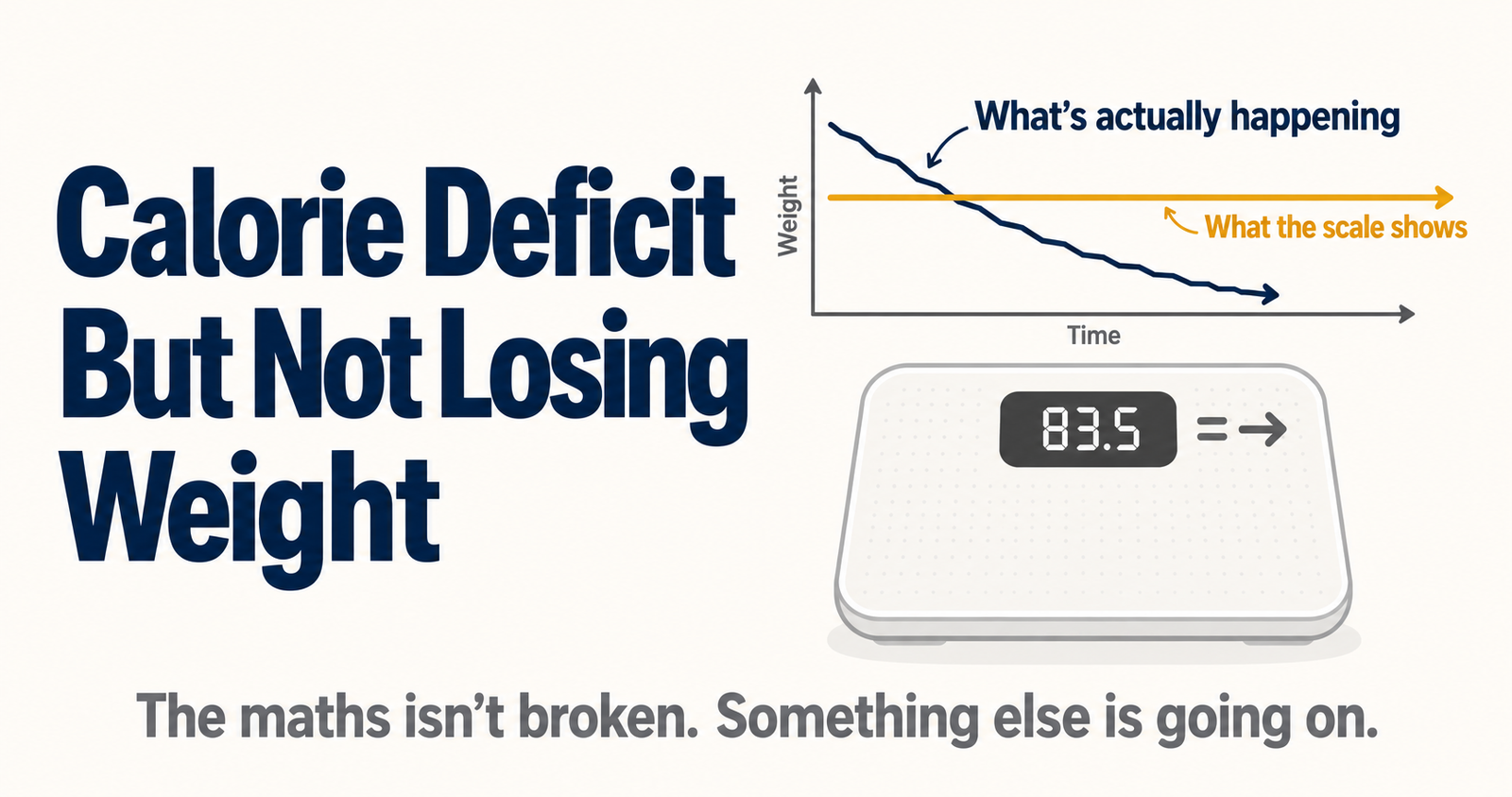
If you’re in a calorie deficit but not losing weight, the first thing worth saying is this: the maths isn’t broken. Energy in versus energy out still holds. But there are more variables inside that equation than most advice admits, and several of them can quietly cancel out weeks of genuine progress.
👉 A stalled deficit is almost never a willpower problem. It’s usually one specific thing you haven’t looked at yet.
Sometimes the fat loss is happening and the scale simply can’t see it. Sometimes your body has adapted and the deficit you calculated in January isn’t a deficit anymore. Sometimes something else entirely — sleep, muscle, digestion — is working against you in the background.
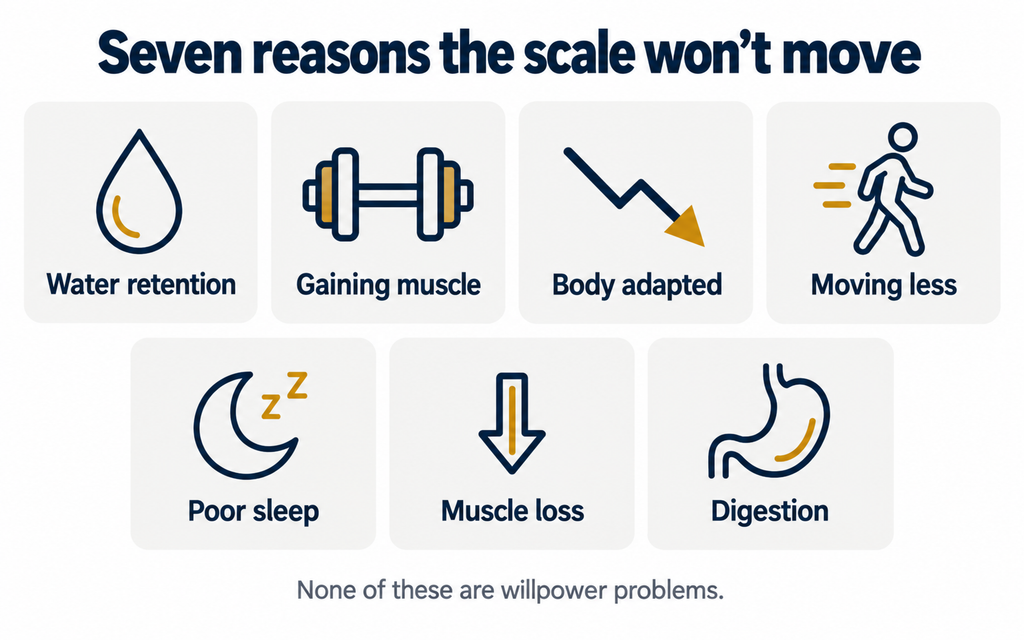
This post covers seven real reasons, in the order they’re most likely to apply. It starts with the uncomfortable one that has to be ruled out first, then works through the ones that catch people who are genuinely doing everything right.
At the end there’s a practical list of what to actually change, and an honest note on when it’s worth getting checked rather than trying harder.
Let’s start with the one nobody wants to hear.
Table of Contents
First, Let’s Rule Out the Obvious One
I’m going to start with the uncomfortable answer, because skipping it would make everything after it dishonest.
The most common reason a calorie deficit isn’t working is that it isn’t actually a deficit.
That’s not me calling you lazy or accusing you of lying to yourself. It’s just that tracking food accurately is genuinely difficult, and almost everyone underestimates — including dietitians, including people who’ve been doing it for years.
Here’s where it usually slips.
Portions get estimated, not measured. A tablespoon of olive oil is 120 calories. Eyeballing it into a pan can easily double that without looking any different.
Liquid calories don’t feel like eating. Milk in coffee, juice, a couple of beers at the weekend. None of it registers as a meal, all of it counts.
Weekends undo weekdays. Five disciplined days and two relaxed ones can average out to no deficit at all. The week looks good in your head and flat on the scale.
Bites and tastes add up. Finishing the kids’ plates, a spoon while cooking, a couple of chips off someone else’s order. Individually trivial, collectively significant.
👉 None of this is a character flaw. It’s just how food tracking works in real life.
How to check honestly
Before assuming something deeper is wrong, spend one week weighing everything. Not estimating — weighing, with a kitchen scale. Log the oil, the milk, the bites. Include the weekend.
If your intake turns out higher than you thought, you’ve found your answer and it’s a fixable one.
👉 But if you do that properly and the numbers genuinely stack up — you’re eating what you think you’re eating and the scale still won’t move — then something else is going on.
That’s what the rest of this post is about.
Reason 1: Water Retention Is Hiding Your Progress
This is the most common answer for people who are genuinely in a deficit — and the most frustrating, because the fat loss is happening. You just can’t see it.
Your body holds a lot of water, and how much it holds shifts constantly. Those shifts are large enough to completely mask several weeks of fat loss on the scale.
Here’s the maths that catches people out. A pound of fat lost is a pound gone. But if you’re holding an extra two pounds of water that week, the scale shows you a pound heavier — and you conclude the deficit isn’t working.
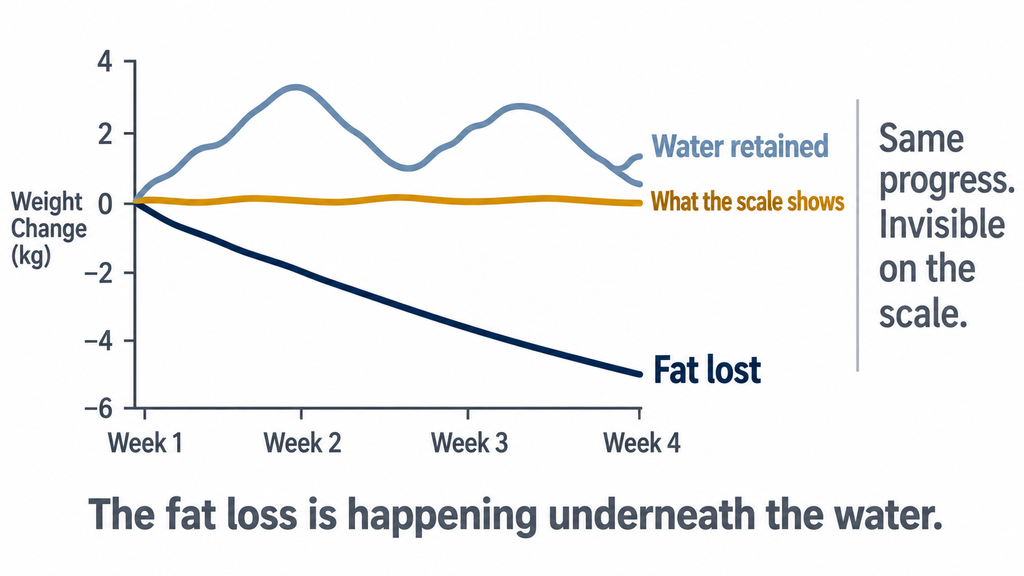
👉 It is working. The scale is just measuring two things at once and only reporting the total.
What causes the water to shift
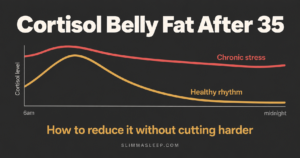
Stress. Elevated cortisol makes your body retain water. And dieting is itself a stressor, which is a particularly cruel loop — the harder you push, the more water you may hold.
New or harder training. If you’ve started resistance training or increased your workload, your muscles retain water as part of the repair process. Common in the first few weeks of any new routine.
Hormonal cycles. For women, water retention through the menstrual cycle can swing several pounds. If you’re weighing at different points in different months, you’re comparing numbers that aren’t comparable.
What to do about it
Stop weighing daily and reacting to it. The daily number is mostly noise.
👉 Weigh at the same time each morning, and only look at the weekly average. Most tracking apps will do this for you. A single day tells you almost nothing; four weeks of averages tells you the truth.
And use something other than the scale. Waist measurements, how clothes fit, progress photos every few weeks. These often show clear change while the scale sits stubbornly still — because they’re measuring the thing you actually care about.
If you’re in a calorie deficit but not losing weight on the scale while your waistband is getting looser, the deficit is working fine. You’re just using the wrong instrument to measure it.
Reason 2: You’re Losing Fat and Gaining Muscle at the Same Time
If you’ve started training — particularly any kind of resistance work — this one might be you.
Muscle and fat weigh the same, but they take up very different amounts of space. A pound of muscle is noticeably more compact than a pound of fat.
So you can lose three pounds of fat and gain three pounds of muscle over the same few weeks, and the scale won’t move at all. Meanwhile your body has changed considerably — smaller waist, firmer arms, clothes fitting differently.
👉 The scale reports one number. It has no idea what that number is made of.
Who this affects most
This shows up strongest in people who are new to resistance training, or returning after a break. Both groups build muscle relatively quickly in the early weeks while simultaneously losing fat — the scale flatlines while everything visible improves.
It’s also common in anyone who’s been dieting for a while and has just added strength work. Your body responds to the new stimulus faster than you’d expect.
How to tell if this is you
The scale won’t answer this question, so use something else.
Measure your waist. If it’s shrinking while your weight holds steady, you’re recomposing — losing fat, gaining or holding muscle. That’s a better outcome than simple weight loss, even though it looks like failure on the bathroom scale.
Take progress photos in the same light, same position, every three or four weeks. Changes that are invisible day to day become obvious across a month.
And notice how your clothes fit. It’s not precise, but it’s honest — and it’s measuring the thing you actually want.
👉 If you’re eating in a calorie deficit but not losing weight while your waist is shrinking and your clothes are looser, don’t change anything. It’s working.
Reason 3: Your Body Adapted to the Deficit
This is the one that explains why something that worked for six weeks suddenly stops.
When you eat less for a sustained period, your body adjusts. It doesn’t sit there passively burning the same amount of energy while you feed it less — it responds by burning less.
Some of that is simple physics. A lighter body needs fewer calories to run. Lose fifteen pounds and your maintenance level genuinely drops, so the deficit you calculated at the start is a smaller deficit now than it was then.
But part of it goes further than that. Your body becomes more efficient under sustained restriction — it does the same work using slightly less energy.
👉 The result is that your deficit slowly closes on its own, without you changing a single thing about what you eat.
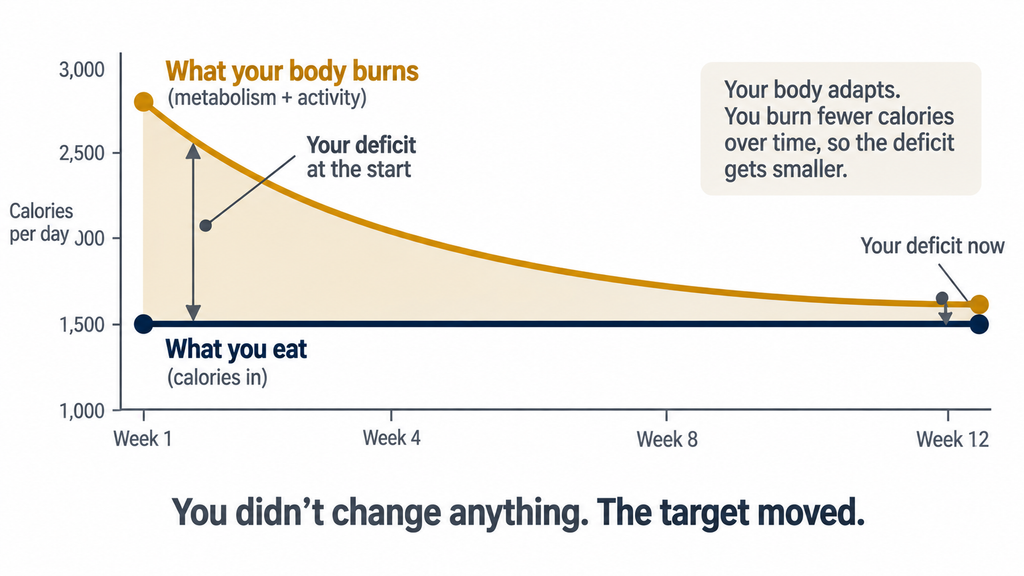
This is also why aggressive dieting often backfires. The harder and longer the restriction, the more your body adapts — and the smaller the deficit you’re actually running by the time you’re weeks in.
What to do about it
Two options, and the second is better than most people expect.
Recalculate. If you’ve lost weight since you set your calorie target, that target is now out of date. Recalculate your maintenance level for your current weight, then set the deficit from there.
Take a diet break. This sounds counterproductive and it isn’t. Eating at maintenance for a week or two lets some of the adaptation reverse, gives you a mental reset, and often makes the next deficit phase more effective than grinding on would have been.
👉 If you’re in a calorie deficit but not losing weight anymore, though it clearly was working before, adaptation is the most likely explanation. And a short break is usually a better answer than cutting further.
One thing not to do
Don’t respond to a stalled deficit by slashing calories again.
You’ll get a short burst of movement, then the same adaptation, and now you’re eating very little with nowhere left to cut. It’s the pattern that leads to people eating 1,200 calories, feeling terrible, and still not losing.
Reason 4: You’re Moving Less Without Noticing
This one is almost invisible, and it might be the biggest of the lot.
Most of the energy you burn in a day has nothing to do with exercise. It comes from everything else — walking around, standing, fidgeting, gesturing, taking the stairs, pacing while on the phone. All the unconscious movement that fills a normal day.
That background movement can account for a substantial chunk of your daily energy burn. And here’s the problem: when you eat less, your body quietly turns it down.
👉 You don’t decide to move less. You just do.
What it actually looks like
You take the lift instead of the stairs without thinking about it. You sit rather than stand while waiting. You fidget less. You take the car for a short trip you’d normally walk. You’re a bit slower getting off the sofa.
None of it feels like a decision. It doesn’t register as laziness because it happens below conscious awareness. But across a full day it adds up to a meaningful reduction in energy burned.
This is one of the main reasons people end up in a calorie deficit but not losing weight while still working out. You did your workout. You also moved considerably less for the other twenty-three hours.
What to do about it
Make some of that movement deliberate rather than leaving it to chance.
👉 Track your steps. Not to hit a magic number, but to see whether they’ve dropped since you started dieting. Most people are surprised. A fall from 8,000 to 5,000 a day is significant and completely invisible without data.
Set a floor rather than a target. A minimum daily step count you don’t go below, even on rest days. It stops the quiet drift.
Add a walk that isn’t exercise. Twenty minutes after dinner, or a longer route to somewhere you were going anyway. Easy to sustain because it doesn’t feel like training.
The point isn’t to burn more through effort. It’s to stop losing what you were already burning without noticing.
Reason 5: Poor Sleep Is Working Against You
This one surprises people, because sleep doesn’t feel like it should have anything to do with a calorie deficit.
It does, and the effect is bigger than most people expect.
When your sleep is short or shallow, several things shift at once. The signals that control hunger and fullness get pushed in the wrong direction — you feel hungrier and satisfied less easily, on exactly the days you’re trying to eat less. Your stress hormones stay elevated, which encourages your body to hold onto water and fat rather than release it.
👉 And critically, poor sleep is one of the strongest drivers of that unconscious drop in daily movement we just covered. A tired body moves less, all day, without being asked to.
Why this catches people mid-diet
There’s a loop here that’s easy to miss.
Dieting is a stressor. Stress affects sleep. Poor sleep increases hunger, lowers your energy, and reduces how much you move. All of which makes the deficit harder to hold and less effective when you do hold it.
So the effort itself can quietly undermine the sleep you need for the effort to work.
The bit that catches people over 35
Deep sleep — the genuinely restorative stage — declines steadily from your thirties. You can spend eight hours in bed and get considerably less of it than you did a decade ago.
That matters here because if your sleep quality has been sliding for years without you noticing, you may be running your deficit against a headwind you didn’t know existed.
👉 We’ve covered this properly elsewhere. If you’re waking up tired despite decent hours, this post explains what’s actually happening. And if you want the fuller picture of how sleep and weight interact, we’ve broken that down here.
For anyone who’s already fixed the obvious sleep basics and suspects age-related decline is the issue, our Resurge review looks at a formula built specifically around that — including where its marketing overreaches.
What to do about it
Protect the first half of your night. That’s where most of your deep sleep happens.
Move alcohol earlier. Keep your bedtime roughly consistent. Cool the bedroom down. None of it costs anything, and for most people it’s where the answer is.
If you’re in a calorie deficit but not losing weight and your sleep has been poor for months, fix the sleep before cutting calories further.
Reason 6: You’ve Lost Muscle Along With the Fat
This one has consequences that outlast the diet itself.
When you lose weight, you don’t only lose fat. Some muscle goes too — and how much depends heavily on how you’re doing it.
That matters because muscle is metabolically active tissue. It burns energy around the clock, even at rest. Lose a meaningful amount of it and your maintenance level drops further than it would have from the fat loss alone.
👉 Which means the deficit you’re running gets smaller, and it stays smaller after the diet ends.
What makes muscle loss worse
Three things reliably accelerate it.
A very aggressive deficit. The faster you try to lose, the higher the proportion that comes from muscle.
Not enough protein. Protein is what signals your body to hold onto muscle while it’s short on energy. Cut calories across the board without protecting protein and muscle goes with the fat.
No resistance training. Muscle responds to demand. If nothing is asking it to stay, it doesn’t.
Combine all three — a hard deficit, low protein, cardio only — and you can lose a significant share of your weight as muscle. The scale looks great. Your metabolism doesn’t.
The compounding problem after 35
You’re already losing muscle to age from your thirties onward, gradually and without noticing. Dieting badly on top of that accelerates something already in motion.
That’s why the same approach that worked at 25 often backfires at 45 — you’re starting from less muscle and losing it faster.
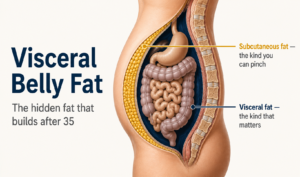
👉 We’ve covered how this works in more detail in our post on visceral belly fat and what changes after 35.
What to do about it
Keep protein high. Especially in a deficit. It’s the single most protective thing you can do.
Add resistance training. Two or three sessions a week is enough. Bodyweight, bands, dumbbells — the specific method matters far less than doing it consistently.
Don’t rush the deficit. A moderate deficit held for longer preserves more muscle than an aggressive one held briefly.
If you’re in a calorie deficit but not losing weight and you’ve been dieting hard on cardio alone, this is worth taking seriously. Losing weight while losing muscle is a short-term win that makes the next attempt harder.
Reason 7: Digestion and Absorption Aren’t Keeping Up
This one won’t stop fat loss on its own, but it can make the whole process considerably harder than it needs to be — and it’s rarely on anyone’s list of suspects.
Before your body can use anything you eat, it has to break it down and absorb it. That’s enzyme work, and enzyme capacity narrows gradually with age.
You don’t lose the ability to digest food. You lose some of your margin for error.
What this looks like in real life
Here’s where you might recognise yourself.
Or you have a slightly richer meal out on a Friday and it sits with you all evening. Your partner eats the same thing and feels fine.
Or the salad with olive oil dressing that’s meant to be your good choice leaves you feeling worse than the sandwich you used to have.
👉 That last one is the pattern that catches people. The “healthy” meal becomes the uncomfortable one, and eating well starts to feel like a punishment.
Why it undermines a deficit
Not because the calories don’t count. They do.
It’s simpler than that: if eating well makes you feel bad, you won’t keep doing it.
Plenty of people abandon a perfectly good way of eating not because it stopped working, but because it made them uncomfortable every evening. That’s not a willpower failure. It’s a reasonable response to feeling rubbish.
There’s a knock-on effect too. Poor fat absorption means less efficient uptake of the fat-soluble vitamins that come with it, and being persistently short on those doesn’t help energy or hormone function.
👉 We’ve broken down how this works properly in our post on digestive enzymes and what changes after 35.
What to do about it
Chew properly — genuinely the easiest win available. Don’t put your biggest, richest meal last thing at night. Eat sitting down and unhurried rather than standing at the counter.
None of that costs anything, and for most people it closes the gap.
What to Actually Do
The formula isn’t eat less. It’s eat enough to protect your muscle, move enough to keep your burn, and sleep enough to let both work.
Here’s how that translates into practice, ordered by what tends to make the biggest difference.
1. Verify the deficit properly, once
Before changing anything else, spend one week weighing everything. Oil, milk, bites, weekends included.
👉 If the numbers come out higher than you thought, you’ve found your answer. If they stack up, you can stop questioning it and move down this list with confidence.
Do it once, honestly, and you never have to wonder again.
2. Stop reacting to the daily scale
Weigh at the same time each morning, then ignore the individual numbers entirely. Look only at the weekly average.
Add a waist measurement every two weeks and a photo every month. If the scale is flat but your waist is shrinking, the deficit is working and you’re using the wrong instrument.
3. Get your protein up
This is the highest-leverage change most people can make in a deficit.
Protein protects muscle while you’re short on energy, and it keeps you fuller, which makes the whole thing easier to sustain. Build meals around it rather than treating it as a side.
4. Add resistance training
Two or three sessions a week. Bodyweight, bands, dumbbells — whatever you’ll actually do.
You’re not training to burn calories. You’re training to keep the muscle that determines your resting burn, so this deficit doesn’t leave you worse off than you started.
5. Set a step floor
Not a target — a minimum you don’t drop below, including rest days.
This stops the quiet decline in background movement that happens automatically when you’re eating less. Check your current average first; most people find it’s fallen since they started dieting.
6. Protect your sleep
Particularly the first half of the night, where most of your deep sleep happens.
Move alcohol earlier, keep bedtimes roughly consistent, cool the room. If you’re running a deficit on broken sleep, you’re fighting yourself.
7. Recalculate, or take a break
If you’ve lost weight, your maintenance level has changed and your target is out of date. Recalculate it.
And if you’ve been dieting for months without a pause, a week or two at maintenance is often more productive than pushing harder. Adaptation partially reverses, and you come back to it better.
What not to do
⚠️ Don’t judge any change in under three weeks. Water retention alone can mask a month of progress.
When It’s Worth Getting Checked
If you’re still in a calorie deficit but not losing weight after all of that, everything above assumes your body is working normally. Usually it is. But sometimes it isn’t, and no amount of adjusting your steps or your protein will fix something medical.
If you’ve genuinely worked through this list — verified the deficit, given it three months, protected your sleep and your protein — and nothing has moved at all, it’s worth a conversation with your doctor.
Thyroid function and PCOS
An underactive thyroid slows your metabolism and causes fatigue and low mood that often get blamed on dieting itself. Polycystic ovary syndrome makes fat loss noticeably harder, particularly around the midsection.
Both are common, both are testable, and both are manageable once identified. If your cycles are irregular alongside stubborn weight, raise that specifically.
Medication
Plenty of common prescriptions affect weight — some antidepressants, steroids, certain blood pressure medications, hormonal contraceptives and others.
If your weight became stubborn around the time a medication started, mention it to whoever prescribed it. That’s a conversation about alternatives, not a reason to stop taking anything.
Perimenopause
For women in their forties and beyond, hormonal changes shift where fat is stored and how easily it’s lost. This is normal, not a failure, but it does change what works — and knowing that is genuinely useful.
When to book the appointment
⚠️ Worth going if any of these apply.
You’ve been in a verified deficit for three months with no change in weight or measurements. The weight gain came on suddenly with no change in your habits. You’re exhausted in a way that rest doesn’t fix. You have other symptoms alongside it — hair thinning, feeling cold, irregular cycles, low mood.
👉 None of that means something is seriously wrong. Most of it turns out to be straightforward and treatable.
But if one of these is what’s happening, no article is going to solve it — including this one. And I’d rather tell you that than have you spend another six months tightening a deficit that was never the problem.
The Bottom Line
If you’re in a calorie deficit but not losing weight, the maths isn’t broken. Something in the chain is.
Most of the time it’s one of a handful of things. You’re holding water and the fat loss is happening underneath it. You’re gaining muscle while losing fat, so the scale sits still while your body changes. Your deficit narrowed as you adapted. You’re moving less than you were without realising. Your sleep slipped. You’ve lost muscle along the way. Or your digestion isn’t keeping up.
👉 None of those are willpower problems. They’re all fixable once you can name them.
Where to start
Verify the deficit once, properly. Then stop reacting to the daily scale and start measuring your waist.
After that, protect the two things that make everything else work — your muscle and your sleep. Protein and resistance training for one, a decent first half of the night for the other.
And give it three weeks before you judge anything. Water alone can hide a month of progress.
One last thing
The instinct when a deficit stalls is to cut harder. It’s the wrong move almost every time, and it’s the one that leads to people eating very little, feeling terrible, and still not losing.
You’ve already done the difficult part. You tracked, you ate less, you stuck with it. That discipline isn’t the thing that’s missing.
What’s usually missing is one adjustment somewhere else — and now you know where to look.
💡 Want to go deeper?
Three signals quietly shape hunger, stress and how your body stores fat — and they’re often what’s running underneath a stalled deficit.
👉 I’ve broken all three down in plain language in a free guide: The 3 Hormones Secretly Blocking Your Belly Fat Loss.
You’ve already done the hard part. Add protein to your next meal, check your step count, and give it a month before you judge anything. Every little helps.