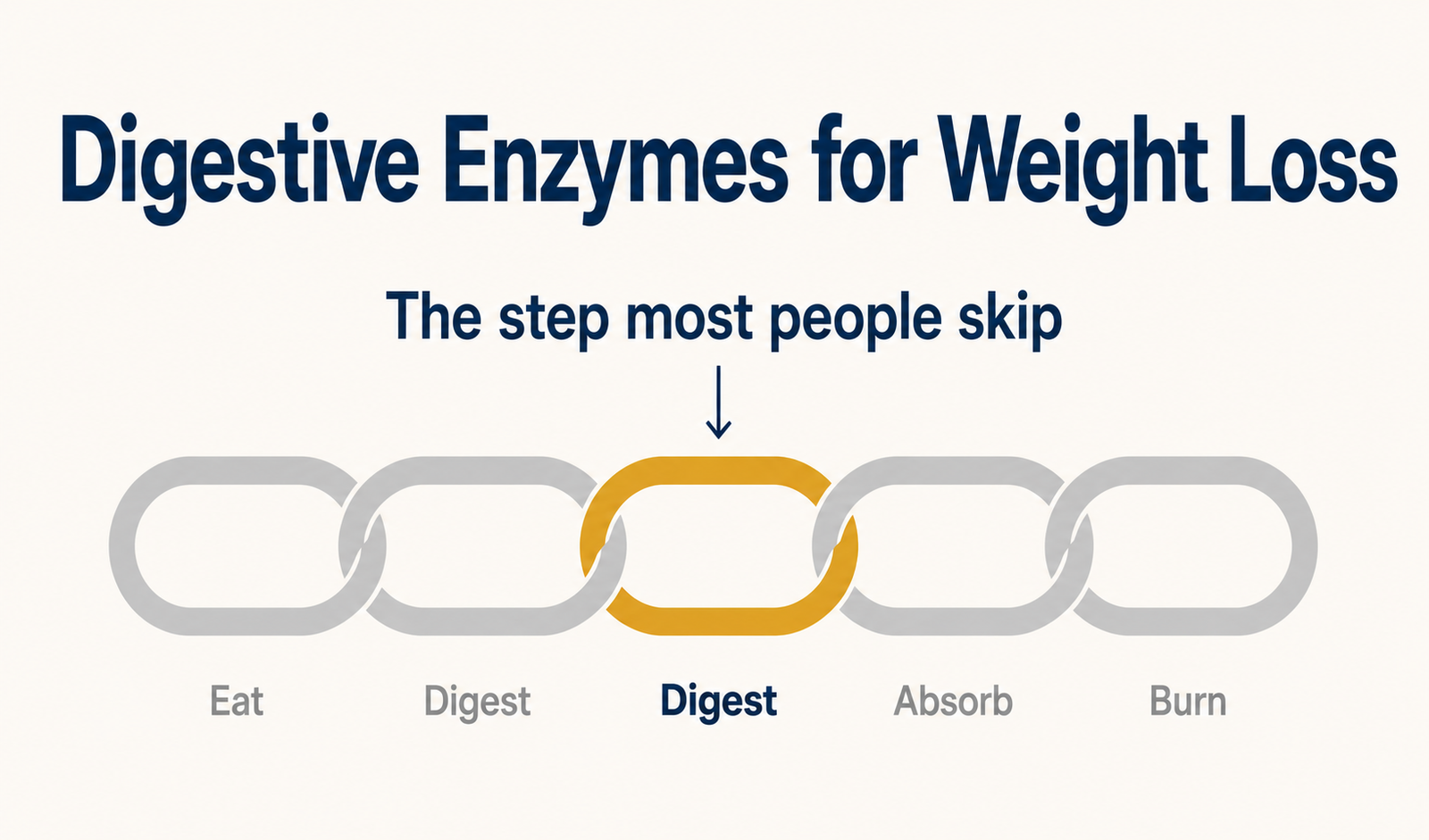
There’s a step in fat loss that almost nobody talks about.
Not calories. Not exercise. Not willpower. A step that happens before any of those matter — and if it isn’t working properly, the rest of your effort has nowhere to go.
Fat can’t be burned in the form your body stores it. It has to be broken down first, into pieces small enough to actually use. That breakdown is a chemical process, handled by enzymes.
👉 No breakdown, no burning. It’s that simple, and that overlooked.
Most weight loss advice starts at the wrong point in the chain. It assumes that if you eat less and move more, the fat takes care of itself. But that assumes every step in between is running properly — and after 35, that’s a bigger assumption than most people realise.
This is where digestive enzymes for weight loss enter the conversation. Not as a magic solution, and not as something you necessarily need to buy. Just as a part of the process that’s quietly doing a job most people have never thought about.
Understanding it won’t transform your body overnight. But it might explain something that’s been frustrating you for years — why the effort you’re putting in doesn’t seem to produce the result it should.
Let’s start with the step everyone skips.
Table of Contents
Your Body Can’t Burn Fat It Hasn’t Broken Down
Here’s the part that changes how you see the whole thing.
Fat doesn’t exist in your body in a form your cells can burn directly. Whether it’s arriving in your dinner or sitting on your waistline, it’s stored as triglycerides — packed together in a structure that’s efficient for storage but useless as immediate fuel.
Before any of it gets used, it has to be taken apart into smaller pieces. Broken down. Unpacked.
👉 That unpacking isn’t something willpower does. It’s a chemical reaction, and it needs a specific tool to make it happen.
That tool is an enzyme.
What an enzyme actually is
Forget the biology-class definition. Here’s the useful version.
An enzyme is a tiny worker that makes one specific chemical reaction happen. Without it, that reaction either happens far too slowly to matter, or doesn’t happen at all.
Your body runs thousands of these reactions constantly. Each has its own dedicated enzyme, and they don’t cover for each other. The one that handles protein can’t touch fat. The one that handles fat can’t touch anything else.
That specificity matters. If one particular enzyme is underperforming, one particular job doesn’t get done properly — and there’s no backup.
Two places fat gets broken down
This is where most articles get sloppy, so let’s be precise.
Fat gets broken down at two completely different points in your body, by two different enzymes that happen to share a family name.
👉 In your gut, when you eat fat, it has to be broken down before your body can absorb it.
👉 In your fat cells, when your body needs energy, stored fat has to be released before it can be burned.
Both steps are real. Both involve enzymes. But they’re separate processes with separate tools — and confusing them is why so much of what you read about enzymes and weight loss doesn’t quite add up.
We’ll untangle both. Because understanding which is which is the difference between knowing what actually helps and buying something based on a misunderstanding.
What Digestive Enzymes Actually Do
When people talk about digestive enzymes for weight loss, they’re usually talking about three enzymes. Each handles a different type of food, and none can do another’s job.
Amylase breaks down carbohydrates into sugars.
Protease breaks down protein into amino acids.
Lipase breaks down fat.
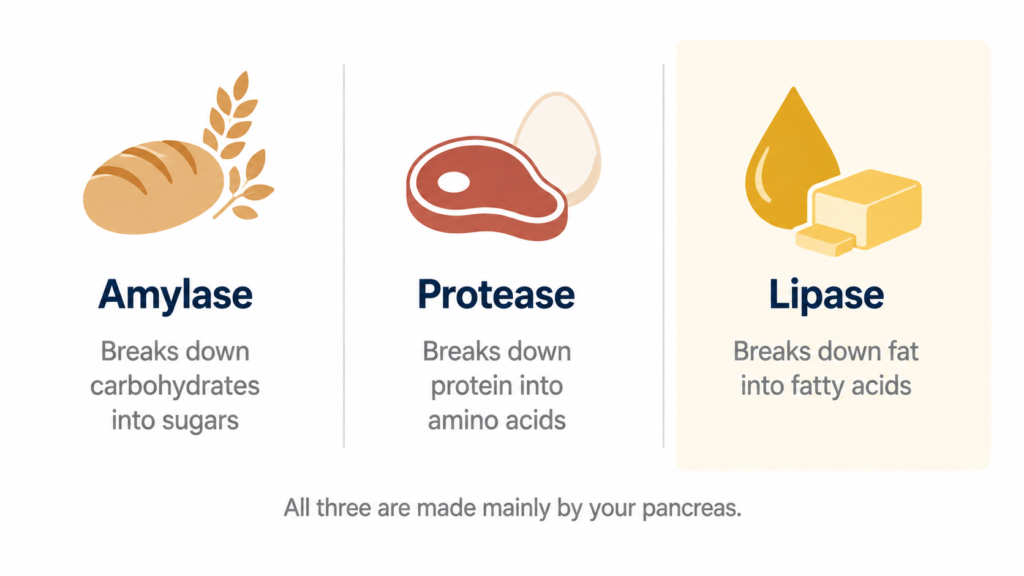
All three are produced mainly by your pancreas, which releases them into your small intestine when food arrives. Three specialists on the same team, each with one narrow job.
Lipase is the one that matters here
Its job is specific. Lipase breaks triglycerides down into free fatty acids and glycerol — the smaller pieces your body can actually absorb and use.
It doesn’t work alone. Lipase works alongside bile from your liver, which breaks fat into smaller droplets first so the enzyme has more surface to work on. Two systems, one job.
Small amounts of lipase are made in your mouth and stomach, but the pancreas does the heavy lifting. Pancreatic lipase handles the bulk of fat digestion in the small intestine.
Now the part most articles won’t tell you
Here’s the distinction that changes everything, and almost nobody writing about digestive enzymes for weight loss makes it clearly.
There is more than one kind of lipase.
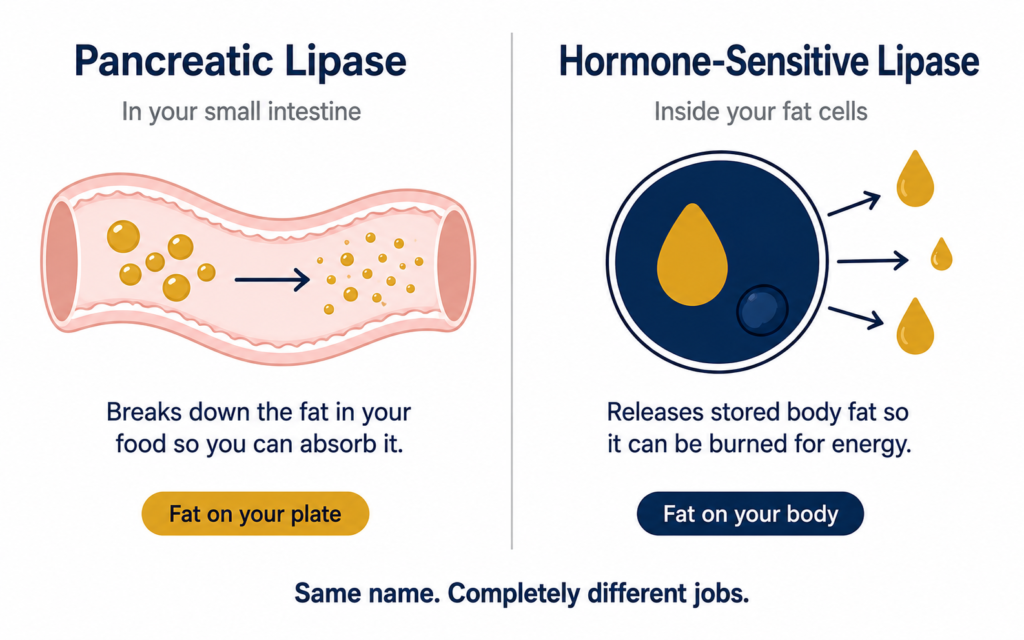
👉 Pancreatic lipase works in your small intestine. Its job is breaking down the fat in your food so you can absorb it. This is what “digestive enzymes” refers to.
👉 Hormone-sensitive lipase works inside your fat cells. Its job is releasing stored body fat so it can be burned for energy.
Same family of enzymes. Completely different jobs, in completely different places.
Why this matters to you
Read any supplement page selling digestive enzymes for weight loss and you’ll notice the language gets vague right at this point. It’ll say enzymes “break down fat” — technically true — and let you assume that means the fat on your stomach.
It doesn’t. Digestive lipase breaks down the fat on your plate, not the fat on your waist.
👉 That’s not a reason to dismiss digestive enzymes. It’s a reason to understand what they actually do, so you know whether it’s relevant to your situation.
Because poor fat digestion causes real problems — when lipase is insufficient, your body struggles to absorb fat and the fat-soluble vitamins that come with it, A, D, E and K — and those problems have downstream effects worth knowing about.
That’s what the next section covers.
When Enzyme Activity Drops
So what actually happens when your digestive enzymes aren’t keeping up?
Not dramatic illness. When people search digestive enzymes for weight loss, they’re rarely dealing with a diagnosable condition. What we’re talking about here is the low-grade version — enzyme activity that’s adequate but not optimal, doing the job but not doing it well.
The signs are easy to miss because they don’t look like a fat loss problem. They look like ordinary discomfort.
👉 Food that feels like it sits heavily after meals
👉 Bloating that shows up predictably an hour or two after eating
👉 Feeling uncomfortably full from portions that never used to bother you
👉 Fattier meals hitting you harder than they used to
👉 Digestion that’s just generally slower and less comfortable than it once was
Most people put these down to age, or stress, or something they ate. Rarely does anyone connect them to how well their body is processing what they eat.
Why this affects more than digestion
Here’s where it becomes relevant to your weight, even though digestive lipase doesn’t touch stored fat directly.
When digestion runs poorly, a few things follow.
Nutrient absorption suffers. If fat isn’t being broken down properly, the fat-soluble vitamins riding along with it — A, D, E and K — aren’t absorbed properly either. Those vitamins are involved in hormone production, immune function and energy metabolism. Being short on them doesn’t make you gain weight directly, but it doesn’t help anything work well.
Energy takes a hit. Poor digestion means less efficient energy extraction from food. That shows up as sluggishness after meals rather than the lift you’d expect from eating.
Comfort drives behaviour. This one gets overlooked. If eating well leaves you bloated and uncomfortable, you’re less likely to stick with it. Plenty of people abandon a perfectly good way of eating not because it wasn’t working, but because it made them feel awful.
Being straight about the limits
Let’s be clear about what this does and doesn’t mean.
Poor digestion is not the reason you have belly fat. Fixing your enzymes will not melt stored fat off your midsection, and anyone telling you otherwise is selling rather than explaining.
👉 What it does mean is that digestion is one link in a chain — and a link running poorly makes everything downstream harder than it needs to be.
If you’re eating well, feeling worse for it, and wondering why the effort isn’t paying off, this is a genuinely worth checking. Not as the answer. As one possible piece of it.
Why This Changes After 35
Here’s where I have to be careful, because this is exactly the point where most supplement content overstates its case.
The claim you’ll see on almost every page selling digestive enzymes for weight loss is that enzyme production “collapses” after 30 or 35. That’s tidy, alarming, and not quite what the research says.
What the evidence actually shows
The pancreas does change with age. Its volume increases through childhood, plateaus between 20 and 60, then declines — with reduced blood flow, some fibrosis and tissue atrophy. As a result, pancreatic exocrine function is measurably impaired in healthy older people with no digestive disease at all.
One study measuring enzyme output directly found meaningful reductions. Comparing healthy adults averaging 36 years old against healthy adults averaging 72, lipase concentration was 15% lower in the older group — and total enzyme output was down by around 45%.
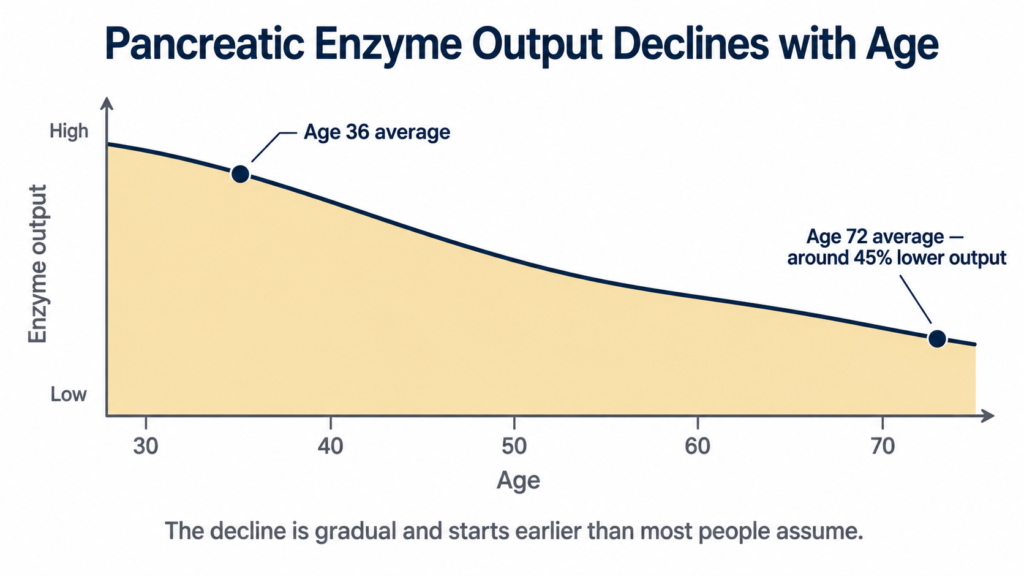
Another found the decline starts earlier than most people assume. Enzyme concentration and output decreased steadily with age from the third decade onward.
👉 So the direction is real. Enzyme capacity does decline, and it appears to start in your thirties rather than your seventies.
But here’s the honest caveat
Not every study agrees. Some research using different testing methods concluded that aging alone does not significantly impair exocrine pancreatic function or the digestive capacity of older people.
That disagreement matters, and pretending it doesn’t exist would be dishonest.
And the clinically significant version of this is genuinely uncommon. Only around 5% of people over 70, and 10% over 80, have pancreatic enzyme insufficiency severe enough to register on standard testing.
What this actually means for you
Put the two together and you get a fair picture, which is this.
👉 Your enzyme capacity likely isn’t what it was at 25. The decline is real, gradual, and starts earlier than most people think.
👉 But for most people under 60, it’s a reduction in reserve rather than a genuine deficiency. Your body still digests food. It just may not do it quite as effortlessly as it once did.
That’s a meaningful distinction. It’s the difference between “your enzymes are failing and you need to fix them” — which is what supplement marketing implies — and “your digestive margin is narrower than it used to be,” which is what’s actually happening.
The second version is less dramatic. It’s also true, and it’s still useful, because a narrower margin means things that never used to bother you might start to.
Heavy meals. Very fatty foods. Eating late. Eating fast. None of these were a problem at 25 because you had capacity to spare. At 45, with less spare capacity, the same habits can start producing symptoms.
👉 That’s the practical takeaway. Not that you’re broken — that you have less room for error than you used to.
Which brings us to what actually helps.
How to Support Your Enzymes Naturally
Most of what actually helps here costs nothing. Start with that before anything else.
Chew properly
The dullest advice on the list, and the most consistently ignored.
Digestion starts in your mouth. Chewing breaks food into smaller pieces, which gives your enzymes more surface area to work on further down. Swallowing half-chewed food doesn’t stop digestion — it just makes every step after it work harder.
👉 If you eat fast, this is the single easiest change available to you. It costs nothing and takes no planning.
Don’t overload a single meal
If your capacity is narrower than it used to be, huge meals are where you’ll feel it.
The same amount of food across two moderate meals is easier to process than one enormous one. This isn’t about eating less overall. It’s about not asking your system to handle everything at once.
Slow down around fat specifically
Fat is the slowest macronutrient to digest and the one that depends most on lipase and bile working well together.
A very fatty meal eaten quickly, late at night, is the combination most likely to leave you uncomfortable. Not because fat is bad — because that’s the scenario that demands the most from the system.
Eat when you’re relaxed
Digestion runs properly when your body is in a rested state. Eating while stressed, rushed, or standing up genuinely does affect how well the process works.
You don’t need a ritual. Just sitting down and not being in a hurry covers most of it.
Some foods contain enzymes naturally
Pineapple contains bromelain. Papaya contains papain. Fermented foods — yoghurt, kefir, sauerkraut, kimchi — contain enzymes and support gut bacteria that assist digestion.
👉 Be realistic about this. Eating pineapple won’t transform your digestion. But these foods are worth including, and they cost nothing extra if you’re eating them anyway.
Where supplements fit
Now the honest part.
Digestive enzymes for weight loss exist as supplements, they’re widely sold, and for some people they genuinely help with comfort — less bloating, less heaviness after meals, easier digestion of fatty foods.
But you need to hold two things in your head at once.
👉 What they can do: support the digestive process, particularly if your capacity has narrowed with age or you struggle with fattier meals.
👉 What they can’t do: release stored body fat. That’s hormone-sensitive lipase, working inside your fat cells — a completely different enzyme in a completely different place, and no digestive supplement touches it.
Any product implying otherwise is being loose with the truth, and now you know enough to spot it.
On HoneyBurn specifically
Since it comes up constantly in searches for digestive enzymes for weight loss — HoneyBurn is built around lipase support, and it’s the product most often searched alongside these questions.
I’ve reviewed it properly, including where its marketing gets ahead of the evidence and who it genuinely suits.
👉 If you want the full breakdown — ingredients, honest limitations, and whether it makes sense for your situation — it’s in our HoneyBurn review.
One thing worth saying plainly
If your digestion has changed noticeably and quickly, or you’re experiencing persistent symptoms, that’s a conversation for your doctor rather than a supplement decision. Enzyme insufficiency is a real, testable condition — and if that’s what’s happening, you want it diagnosed properly rather than guessed at.
The Bottom Line
Here’s what I want you to walk away with.
Fat loss isn’t one process. It’s a chain — and most advice only ever talks about two links in it. Eat less. Move more.
But between the food on your plate and the fat on your body, there are steps happening that nobody mentions. Digestion is one of them. It’s the link most people never check, and after 35 it’s often not running as smoothly as it used to.
👉 That doesn’t make it the answer. It makes it a link worth checking.
What’s actually true
Let’s be clear about the honest version, because you won’t find it stated plainly on many pages selling digestive enzymes for weight loss.
Digestive lipase breaks down the fat in your food so you can absorb it. A different enzyme entirely — hormone-sensitive lipase — releases the fat already stored on your body. Supporting the first one does not do the job of the second.
Enzyme capacity does decline with age, starting earlier than most people assume. But for most people under 60, that’s a narrower margin rather than a genuine deficiency.
And better digestion won’t strip fat off your waistline. What it can do is make eating well feel comfortable instead of punishing — which matters more than it sounds, because nobody sticks with a way of eating that leaves them bloated and heavy every evening.
Where to start
Before you consider digestive enzymes for weight loss, start here. Chew properly. Don’t overload single meals. Go easier on very fatty food late at night. Eat sitting down, unhurried.
None of that costs a penny, and it addresses the actual issue for most people.
If you want to go further, digestive enzyme supplements are worth understanding — just understand them accurately, which you now do.
👉 You’re not broken. You’ve just got less room for error than you had at 25. Adjust for that, and the whole thing gets easier.
💡 Want the bigger picture?
Digestion is one link in the chain. There are three others that quietly shape hunger, cravings and fat storage — and most people have no idea which one is working against them hardest.
👉 I’ve broken all three down in plain language in a free guide: The 3 Hormones Secretly Blocking Your Belly Fat Loss.
Grab it, find out where you stand, and you’ll understand your body better than most people ever will.
You don’t have to overhaul anything. Chew a bit slower, ease off the late heavy meals, and see how you feel in a fortnight. Every little helps.