You can lose weight everywhere else and still carry a belly that won’t shift.
Arms lean out. Face slims down. But the middle stays — firm, round, and stubborn in a way the rest of you isn’t.
That’s not a willpower problem. It’s a clue.
Because the fat around your midsection after 35 often isn’t the soft kind you can pinch. It’s a different type entirely — one that sits deeper, behaves differently, and answers to different rules than the fat you had at 25.
It’s called visceral belly fat. And understanding it changes everything about how you approach getting rid of it.
Here’s the part most advice skips: your body doesn’t just store more fat as you get older. It stores it in a different place, for different reasons — and the belly is where it lands first.
That shift tends to start somewhere around your mid-thirties. Quietly. You don’t notice it happening. You just notice, a few years later, that the middle isn’t responding to the things that used to work.
This isn’t about needing to try harder. Most people over 35 are already trying plenty. It’s about understanding what actually changed — because the belly you’re fighting now is a different opponent than the one you’d have faced a decade ago.
Let’s break down what visceral belly fat actually is, why it builds after 35, and what genuinely helps you lose it.
Table of Contents
Your Body Starts Storing Fat in a New Place
Here’s something nobody warns you about.
The way your body decides where to put fat isn’t fixed. It changes as you age — and the change isn’t in your favour.
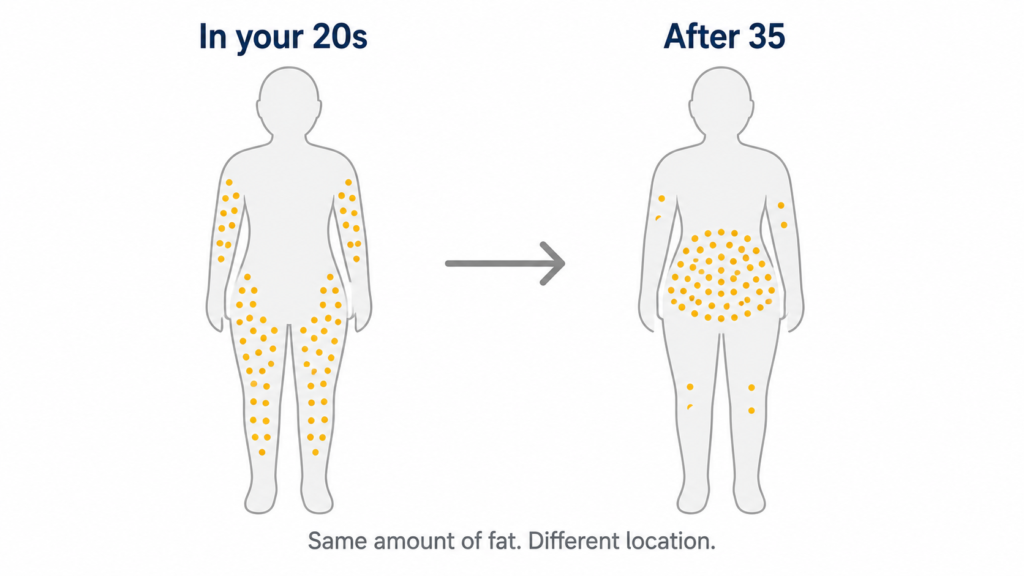
In your twenties, your body tends to store fat under the skin, spread around. Hips, thighs, arms, backside. Annoying, but harmless. You could see it and pinch it, and it mostly stayed put in those areas.
After 35, that pattern shifts. Your body starts sending more of its fat storage to one specific place: your abdomen. And not just under the skin — deeper, into the space around your internal organs.
👉 Same amount of fat. Different postcode.
This is why so many people over 35 say the same thing. Their weight hasn’t changed much, but their shape has. The belly got rounder while everything else stayed roughly the same. That’s not your imagination. It’s your body following new storage instructions.
Why the belly, and why now?
A big part of it comes down to shifting hormone levels — the signals that tell your body where to park fat change as you move through your thirties and forties. For women, this shift accelerates approaching menopause. For men, it’s slower but still real.
The details differ between individuals. But the direction is the same for almost everyone: away from the limbs, toward the middle.
There’s a second factor stacked on top of it, and it might be the more important one. It’s not about where fat goes — it’s about what’s quietly disappearing while you’re not looking.
We’ll get to that shortly. First, it’s worth understanding that not all belly fat is the same thing — because the deeper kind is the one that actually matters.
The Two Kinds of Belly Fat (And Why One Matters More)
Not all belly fat is the same. This is the part that changes how you should think about the whole problem.
There are two completely different types sitting around your middle.
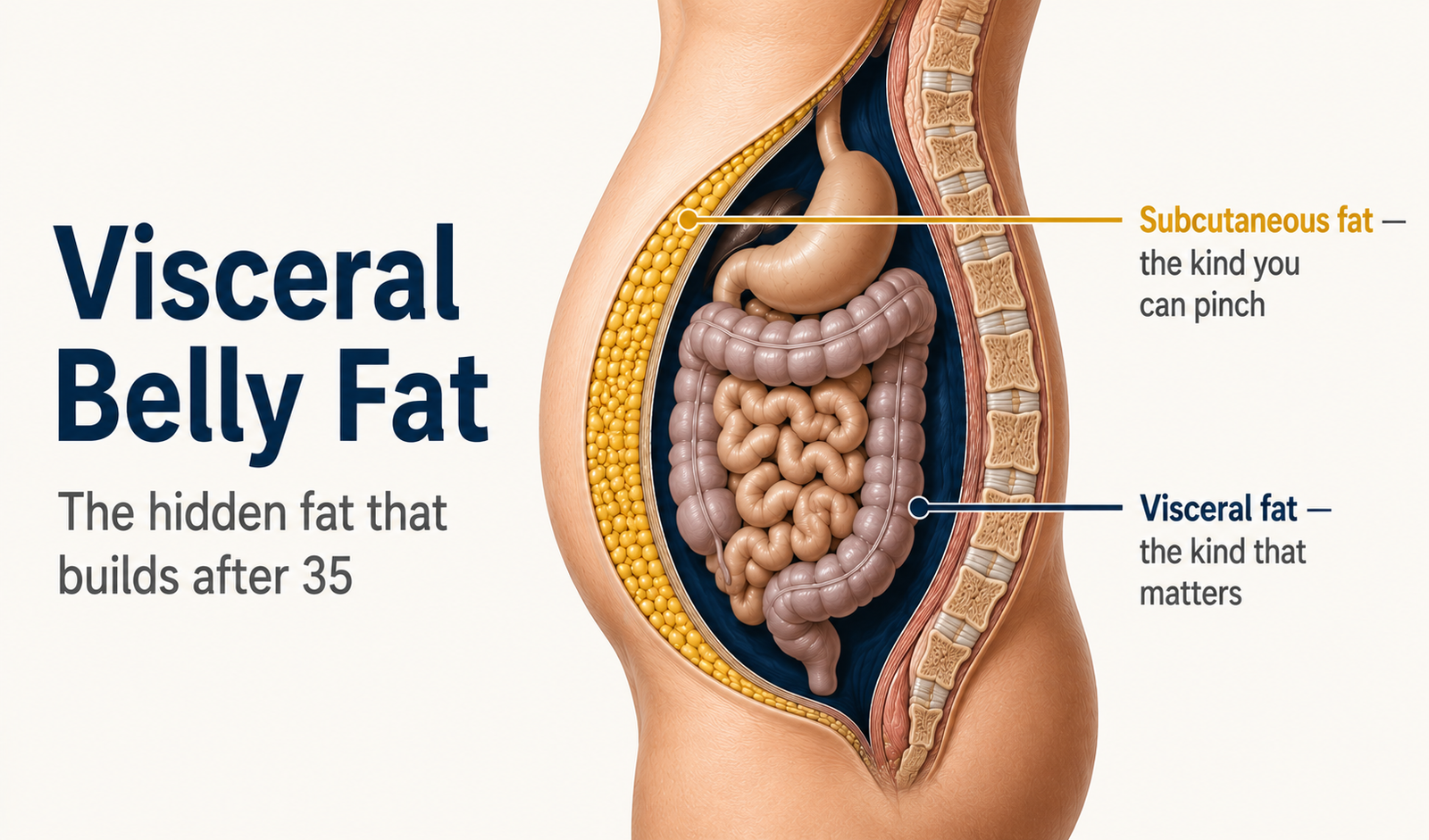
Subcutaneous fat is the kind you can pinch. It sits just under the skin, the soft layer you can grab with your hand. It’s what most people picture when they think of belly fat. It’s also, for the most part, the harmless kind. Annoying to look at, but not doing much damage.
Visceral belly fat is the kind you can’t pinch. It sits deeper, packed into the space around your internal organs — your liver, your pancreas, your intestines. You can’t grab it because it’s underneath the muscle wall, not on top of it.
👉 Here’s what makes the difference matter: a belly can be firm and round rather than soft and squishy. That firmness is often visceral belly fat pushing outward from the inside. The belly feels hard because the fat isn’t sitting on top of the muscle — it’s behind it.
Why visceral belly fat is the one to care about
Subcutaneous fat mostly just sits there. Visceral belly fat is active. It behaves less like storage and more like a troublemaker that interferes with how your body works.
Because it’s wrapped around your organs, it affects how they function. It’s linked to the way your body handles blood sugar, processes fat, and manages inflammation. This is why visceral belly fat is considered the more serious of the two — it’s not just a cosmetic issue, it’s tangled up with how well your internal systems run.
And it’s the type that increases after 35. The redistribution we talked about isn’t sending more soft, pinchable fat to your belly. It’s sending more of the deep, visceral kind.
That’s a double problem. The fat that’s increasing with age is also the fat that matters most for your health — and the fat that’s hardest to shift with the usual approaches.
The organ connection
There’s one organ that sits right in the middle of the visceral belly fat story: your liver.
Your liver is one of the hardest-working organs in fat processing. When visceral belly fat builds up around it and starts to interfere, that processing gets less efficient — which can make the whole cycle harder to break.
👉 If the organ side of this interests you, our Ikaria Lean Belly Juice review looks at a formula built specifically around the liver and the compounds that clog it. It’s one angle on the visceral belly fat problem worth understanding.
The takeaway here is simple. When you’re trying to lose belly fat after 35, the deep visceral kind is usually the real target. And that changes which methods actually work — which brings us to the thing quietly making all of this harder.
The Muscle You’re Quietly Losing
Here’s the factor almost nobody connects to visceral belly fat. And it might be the most important one on this page.
Starting somewhere in your thirties, you begin losing muscle. Slowly, steadily, without noticing. It has a name — sarcopenia — and it happens to everyone who doesn’t actively work to stop it.
The losses are small year to year. So small you don’t feel them. But they add up, and by your late thirties and into your forties, you’re carrying noticeably less muscle than you did in your twenties — even if the scale says you weigh the same.
Why this matters for your belly
Muscle isn’t just for strength. It’s metabolically active tissue — meaning it burns energy around the clock, even while you’re sitting still.
The more muscle you carry, the more calories your body burns at rest. The less muscle you carry, the fewer it burns.
👉 So as muscle quietly disappears, your resting calorie burn drops with it. The exact same meals you always ate now leave a little surplus where they used to break even. And that surplus tends to get stored — increasingly, as we’ve seen, around your middle.
This is the piece that makes people feel like their body betrayed them. Nothing changed on their end. Same food, same habits. But the machine burning that food got smaller, so the same inputs produce a different result.
The scale hides it
Here’s why this is so easy to miss.
Muscle is denser than fat. So you can lose muscle and gain fat at the same time, and the scale barely moves. On paper, your weight looks stable. In reality, your body composition has quietly shifted — less of the tissue that burns energy, more of the tissue that gets stored.
Two people can weigh exactly the same and look completely different, because one kept their muscle and one didn’t.
That’s why the scale is a poor guide after 35. It can’t tell you what’s muscle and what’s fat. It just gives you one number that hides the very change that matters most.
Why this compounds the belly problem
Put the two factors together and you see the full picture.
Your body is redistributing fat toward your middle. At the same time, it’s losing the muscle that would help you burn that fat off. One force pushes fat toward your belly. The other removes your ability to deal with it.
That’s the real reason belly fat gets harder after 35. Not one change — two, working at the same time, in the same direction.
And it explains why the thing most people reach for to fix it often makes it worse.
Why “Just Do More Cardio” Backfires
So you try to fix it the way everyone’s told to. More cardio. Longer runs, more time on the treadmill, more calories burned.
It makes sense on paper. Burn more, lose more. And for a while, it might even work a little.
But here’s the trap.
Cardio doesn’t protect muscle. And muscle is the thing you can’t afford to lose.
Long sessions of steady cardio burn calories while you’re doing them. But they do almost nothing to build or preserve muscle. In fact, large amounts of cardio with no strength work — especially combined with eating less — can cost you muscle along with fat.
👉 Think about what that means after 35. You’re already losing muscle to age. Now you’re doing something that can strip away even more of it. You’re burning fat today at the cost of the very tissue that keeps your metabolism running tomorrow.
It’s a short-term win that deepens the long-term problem.
The cycle it creates
Here’s how it usually plays out.
You do lots of cardio and eat less. The scale drops a bit — mostly water and some muscle along with the fat. You’re pleased.
Then it stalls. Because you’ve lost muscle, your resting burn is now even lower than when you started. So you have to do even more cardio just to keep losing. Which costs more muscle. Which lowers your burn again.
Round and round, working harder for less, until you’re exhausted and the visceral belly fat still hasn’t shifted.
This is the point where most people conclude their body is broken or their age has beaten them.
👉 It’s neither. They’ve just been using a tool that works against the real problem.
It’s not that cardio is bad
Cardio has genuine benefits. It’s good for your heart, your mood, your overall health. This isn’t an argument against ever doing it.
The point is narrower: cardio alone is the wrong primary tool for belly fat after 35. On its own, without anything to protect your muscle, it can quietly make the underlying situation worse.
Which raises the obvious question. If endless cardio isn’t the answer, what actually is?
What Actually Works After 35
Now the useful part. If the old approach works against you, here’s what works with you instead.
None of this is extreme. It’s not a crash plan or a punishing regime. It’s a shift in emphasis — away from what stops working after 35, toward what your body actually needs now.
Protect your muscle first
This is the big one. Everything else is secondary.
If muscle loss is quietly lowering your metabolism, then holding onto the muscle you have — and building a little back — is the single most valuable thing you can do. It directly addresses the root of the problem instead of fighting the symptom.
That means resistance training. Lifting something. Bodyweight exercises, resistance bands, dumbbells, machines — the specific tool matters far less than the fact that you’re asking your muscles to work against resistance a few times a week.
👉 You don’t need to become a gym rat. Two or three short sessions a week is enough to change the trajectory. The goal isn’t to look like a bodybuilder. It’s to stop the quiet muscle loss that’s making everything harder.
Prioritise protein
Muscle is built and maintained from protein. As you age, your body actually becomes less efficient at using it — which means getting enough matters more after 35, not less.
Most people trying to lose weight undereat protein. They cut calories across the board and lose muscle in the process. Keeping protein high while you’re in a calorie deficit is what tells your body to hold onto muscle and let go of fat instead.
You don’t need to count every gram. Just make protein the thing you build meals around, rather than an afterthought.
Choose strength over endless cardio
You don’t have to give up cardio. Just stop relying on it as your main tool.
A bit of walking, some movement you enjoy, the odd faster session — all fine and all healthy. But the heavy lifting of belly fat loss after 35 should come from protecting muscle and eating well, not from grinding out hours on a treadmill.
👉 A short strength session does more for your long-term metabolism than a long run ever will.
Don’t ignore the invisible drivers
Two things quietly shape belly fat that have nothing to do with food or exercise.
The first is sleep. Poor sleep affects the signals that control hunger and fat storage — and it tends to worsen with age, right when you least need it to. If your nights are broken, that’s not a side issue. It’s part of the picture.
The second is stress. Chronic stress is linked to fat storage around the middle specifically — the same visceral belly fat we’ve been talking about. Managing it isn’t soft advice. It’s part of the strategy.
👉 If you want to understand how sleep and these hidden signals drive belly fat, I’ve broken the three biggest culprits down in plain language in a free guide — link at the end.
Be patient with the process
Visceral belly fat responds to consistent effort — but not overnight. This is a months-long project, not a two-week one.
The good news is that visceral belly fat, the deeper and more concerning kind, often responds better to these changes than the stubborn subcutaneous fat does. Do the right things consistently and the fat that matters most is often the first to move.
The Bottom Line
If your belly stopped responding after 35, here’s what I want you to take away.
Your body didn’t fail. It changed. And the approach that worked at 25 simply doesn’t match what your body is doing now.
Two things shifted. Your body started sending fat to your middle — the deep, visceral belly fat that wraps around your organs rather than the soft kind you can pinch. And at the same time, you began quietly losing the muscle that keeps your metabolism running.
👉 One force pushes fat toward your belly. The other removes your ability to burn it off. That’s why it feels harder. Because it genuinely is.
But every part of that is workable once you understand it.
Protect your muscle with a bit of resistance training. Build your meals around protein. Stop leaning on endless cardio as your only tool. And don’t ignore the quiet drivers — sleep and stress — that shape visceral belly fat more than most people realise.
None of that is extreme. It’s just aimed at the right target.
The people who stay stuck are usually the ones still fighting this with the old playbook — more cardio, less food, more frustration. The people who break through are the ones who adjust to what their body actually needs after 35.
You’re not fighting your age. You’re learning the new rules. And once you know them, the belly that felt impossible starts to make sense — and starts to move.
💡 Want to understand the hidden side of this?
Beyond muscle and fat storage, there are three signals that quietly drive cravings, stress, and fat storage around your middle — and most people have no idea which one is working against them.
👉 I’ve broken all three down in plain language in a free guide: The 3 Hormones Secretly Blocking Your Belly Fat Loss.
Grab it, find out which one is hitting you hardest, and you’ll understand your belly fat better than most people ever will.
You don’t need to overhaul anything. Add one short strength session this week and build your next meal around protein. Small, repeated, unglamorous — that’s what actually shifts the deep stuff. Every little helps.