You did everything right.
In bed at a reasonable hour. Phone down. A full eight hours on the clock. And then the alarm goes off and you feel like you barely slept at all.
Heavy. Foggy. Reaching for coffee before you’ve properly opened your eyes.
If you’ve been asking why do I wake up tired after 8 hours sleep, here’s the short version: the clock lied to you.
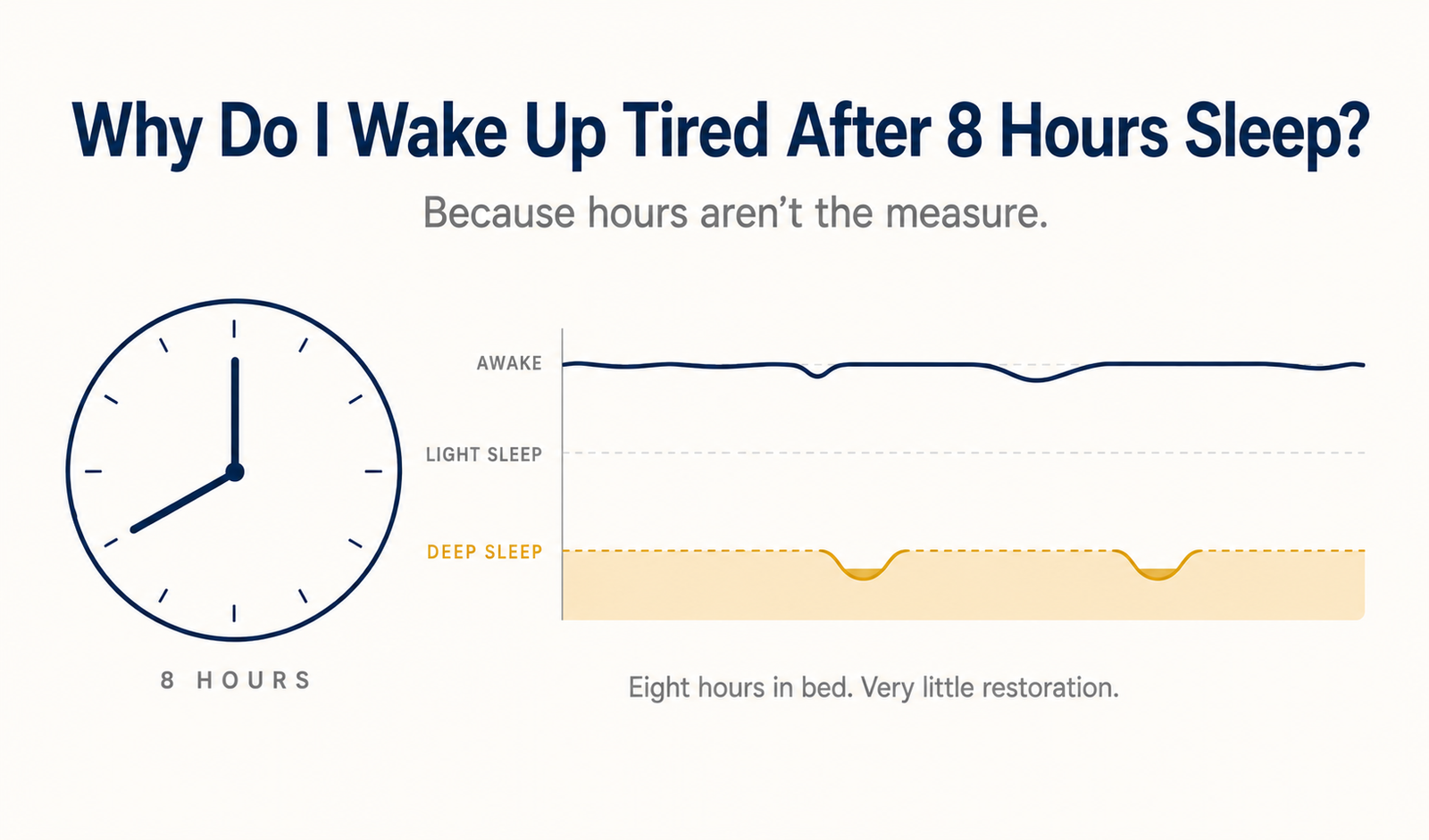
👉 Eight hours in bed is not the same as eight hours of useful sleep.
Sleep isn’t one continuous thing. It runs in stages, and only some of those stages actually restore you. You can spend a full night in bed and barely touch the ones that matter — and if that happens, you’ll wake up feeling exactly the way you’re feeling now, no matter what the clock says.
That’s why “just get more sleep” is such frustrating advice. You did get more sleep. It didn’t help. Because the problem was never the quantity.
This post explains what’s actually happening during those eight hours, why the restorative part goes missing, and what genuinely helps get it back.
It also covers the bit most articles skip — when persistent tiredness isn’t a habits problem at all, and it’s worth getting checked properly.
Let’s start with why the clock is the wrong measure.
Table of Contents
Hours Aren’t the Measure
We’ve all been taught to think about sleep as a number. Get your eight hours and you’ve done your job.
It’s a comforting idea because it’s simple. One number, easy to track, easy to feel good about hitting.
But it measures the wrong thing.
👉 Time in bed tells you how long you were lying there. It tells you nothing about what your body actually managed to do in that time.
Think of it like this. Two people both spend an hour at the gym. One trains properly. The other wanders around, checks their phone, does three half-hearted sets and leaves. Same hour. Completely different result.
Sleep works the same way. The clock counts the hour. It has no idea what happened inside it.
What “quality” actually means
Sleep quality isn’t a vague wellness word. It refers to something specific and measurable — how much of your night you spend in the stages that do the restorative work.
Some stages are light. You’re asleep, but barely — easily woken, drifting. Useful for transitions, not much else.
One stage does the heavy lifting. That’s where physical recovery happens, where your body repairs and resets. It’s also the stage that determines whether you wake up feeling human or feeling flattened.
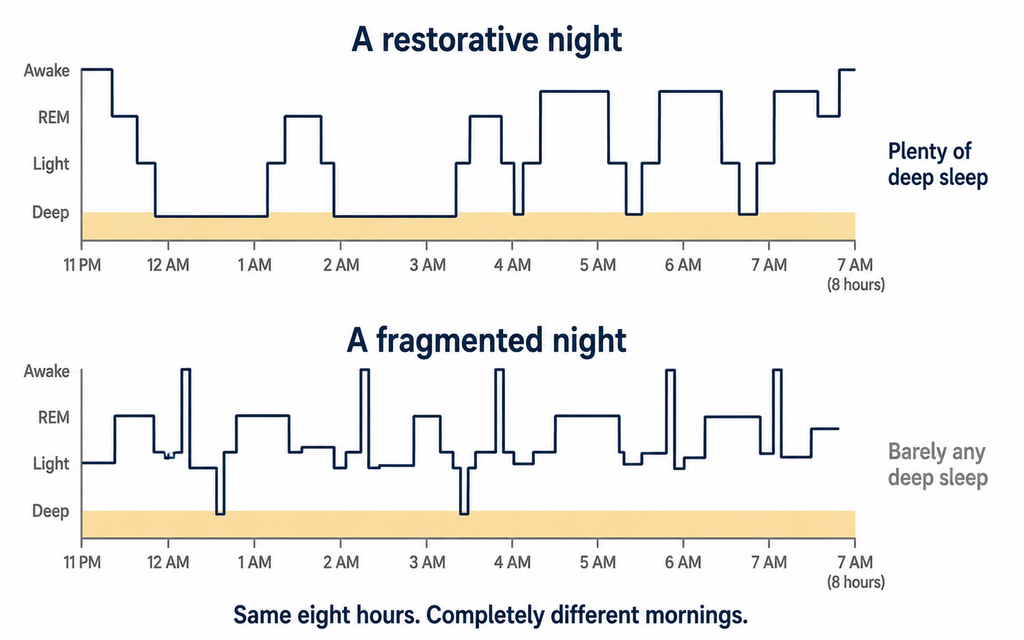
If your night is mostly light sleep with very little of the deep stuff, you’ll hit eight hours and still wake up exhausted. On paper you slept. In practice, the restoration never happened.
Why this explains your morning
So when you ask why do I wake up tired after 8 hours sleep, the honest answer is usually this.
You didn’t get eight hours of sleep. You got eight hours in bed, and somewhere inside that, a much smaller amount of the sleep that actually counts.
That’s not a discipline problem. It’s not you needing to try harder at something you were already doing right.
It’s a quality problem hiding inside a quantity that looked fine.
What Actually Happens While You Sleep
Your night isn’t one long block of unconsciousness. It’s a sequence — and it repeats.
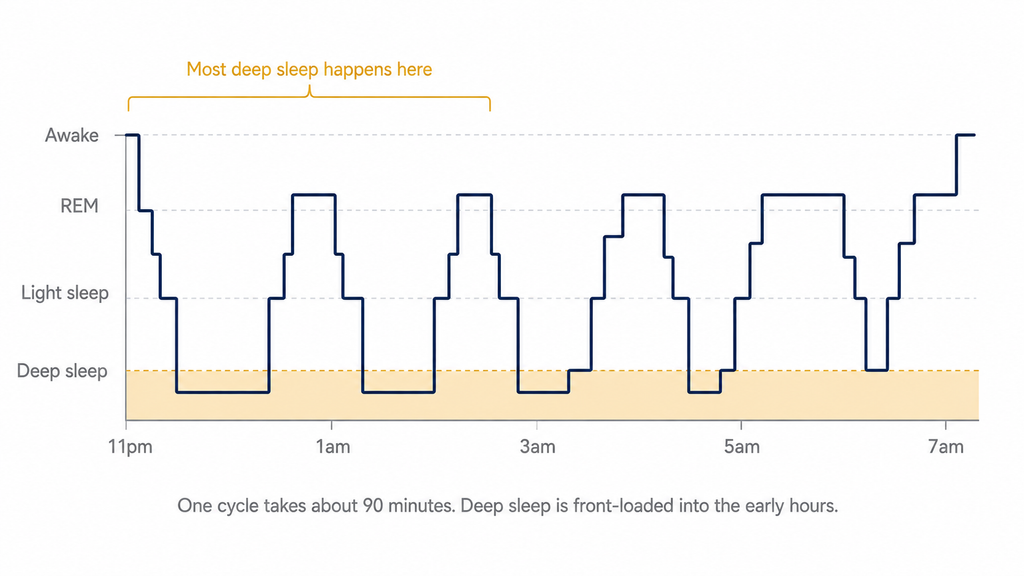
A full sleep cycle takes around 90 minutes, and most adults go through four to six of them a night. Inside each cycle, you move through distinct stages, and they each do something different.
Light sleep — the doorway
The first stage happens right after you drift off and is usually over in under ten minutes. You’re asleep, but only just. A noise, a light, a partner moving — any of it can pull you straight back out.
The second stage lasts longer, roughly 30 to 60 minutes, and your muscles relax further. This one takes up roughly half your total sleep time. It’s genuine sleep and it does useful work, but it isn’t the restorative part.
Deep sleep — the one that matters
This is the stage that determines how you feel in the morning.
Known as slow-wave or delta sleep, it’s the deepest and most restorative stage. Breathing and heart rate slow right down, and it’s very hard to wake someone during it.
👉 This is where physical recovery happens. Growth hormone is released during non-REM sleep, and muscle activity, heart rate and breathing all slow while your body does its repair work.A deep sleep stage typically lasts 20 to 40 minutes. Simply Psychology
You get most of your deep sleep in the first half of the night. Early cycles contain long stretches of it. As the night goes on, those stretches shrink and more of your time shifts into REM instead. Sleep Foundation
REM — the mental stage.
REM stands for rapid eye movement, named after exactly that — your eyes dart around under closed lids while the rest of your body stays completely still.
REM is where most dreaming happens, and it handles memory, learning and emotional processing rather than physical restoration. It starts short — around ten minutes in the first cycle — and grows longer as the night progresses, sometimes up to an hour by the final cycle.
Important as it is, REM isn’t what makes you feel physically restored in the morning. That’s deep sleep’s job.
Why this explains everything
Put it together and the picture becomes clear.
Your deep sleep is front-loaded. It happens mostly in the first few hours, in blocks of 20 to 40 minutes, and once those early cycles pass, the opportunity is largely gone.
👉 So if anything disrupts the first half of your night — a late drink, a racing mind, a light sleep environment, or simply age — you lose deep sleep disproportionately. You can’t make it up later. The rest of the night carries on, filling with lighter stages and REM, and the clock keeps counting.
Eight hours pass. You wake up. And the restoration never happened.
Why You’re Missing the Deep Stuff
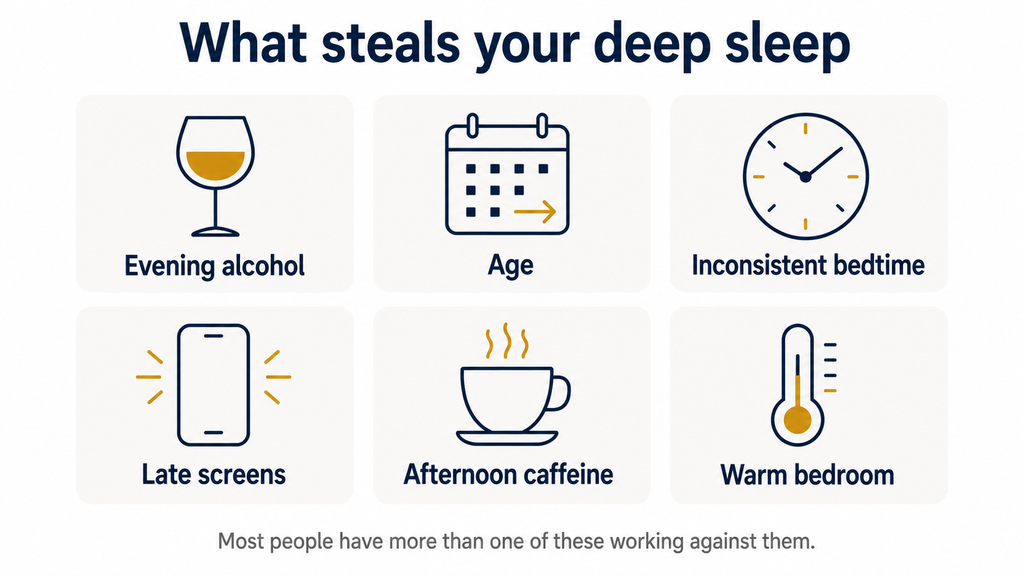
So if deep sleep is the part that restores you, and it’s front-loaded into the first half of your night, what’s stealing it?
Usually more than one thing. Here are the culprits, roughly in order of how often they’re the real answer.
Alcohol in the evening
This one catches people out because a drink genuinely does help you fall asleep faster. That’s why it feels helpful.
But alcohol suppresses deep sleep, particularly in the first half of the night — exactly when you’d otherwise be getting most of it. Then as your body metabolises it, sleep becomes fragmented and shallow in the second half.
👉 You fall asleep quickly, sleep badly, and wake up feeling like you didn’t sleep at all. Which is precisely what happened.
Two glasses of wine at 9pm is one of the most common reasons a full eight hours leaves you flattened.
Age
This is the one nobody warns you about, and it’s unavoidable rather than a mistake you’re making.
Deep sleep declines steadily from your thirties onward. Not suddenly — gradually, year by year, quietly. By your forties you’re getting noticeably less of it than you did at 25, even with identical habits and identical hours in bed.
That’s why this question tends to arrive in mid-life. Nothing about your routine changed. Your capacity for deep sleep did.
👉 If you suspect age-related deep sleep decline is your main issue, our Resurge review looks at a formula built specifically around that problem — including where its marketing overreaches and who it actually suits.
An inconsistent schedule
Your body runs on rhythm. Go to bed at 10pm one night and 1am the next, and it never settles into a reliable pattern.
Weekend lie-ins are the usual offender. Two late nights and two late mornings is enough to shift your internal clock, and then Monday feels like jet lag — because functionally, it is.
Screens and light late at night
Bright light in the evening tells your brain it’s still daytime and delays the whole sequence starting. If your body doesn’t begin winding down until midnight, an 11pm bedtime buys you an hour of lying there, not an hour of sleep.
Caffeine and a warm room
Caffeine has a long half-life — an afternoon coffee is often still working at bedtime. It may not stop you falling asleep, but it can shallow the sleep you get, which is the hardest failure to spot.
Temperature matters too. Your core temperature needs to drop for deep sleep, and an overheated bedroom physically interferes with that.
A racing mind
If you’re lying there with tomorrow’s problems running on a loop, your body stays in daytime mode. Stress hormones don’t switch off just because the light did.
This is the “wired but tired” state — exhausted and unable to switch off simultaneously. It delays sleep onset and keeps what follows shallow.
Something you can’t fix yourself
⚠️ One more possibility, and it’s important.
If you’re doing everything above correctly and still waking exhausted, an underlying sleep disorder may be the answer. Sleep apnea in particular causes repeated micro-awakenings you have no memory of — dozens or hundreds a night, each one pulling you out of deep sleep.
You’d have no idea it was happening. You’d just wake up shattered after a full night, every night.
That’s a doctor conversation, not a habits problem. We’ll come back to it properly near the end.
Signs It’s Quality, Not Quantity
If you’re not sure whether this applies to you, these are the patterns that point to a quality problem rather than a shortage of hours.
👉 You wake up feeling like you need another few hours, no matter how long you were in bed
👉 You need an alarm every single day, and you’d sleep through it given the chance
👉 You hit a wall in the early afternoon that coffee only partly fixes
👉 You wake up during the night — even briefly, even if you fall straight back asleep
👉 You’re exhausted by evening but can’t switch off when you finally get into bed
👉 Weekends don’t fix it, no matter how long you lie in
👉 You don’t feel properly awake until an hour or two after getting up
👉 Your partner mentions snoring, or that you seem restless in the night
If several of those land, the answer to why do I wake up tired after 8 hours sleep almost certainly isn’t how long you’re sleeping.
The weekend test
Here’s a simple way to check.
Sleep in on a weekend. Give yourself ten hours instead of eight, with nothing to get up for.
👉 If you wake up genuinely restored, hours may have been part of your problem.
👉 If you wake up feeling roughly the same — heavy, groggy, unrefreshed — then more time in bed isn’t the answer. You’ve just proved it to yourself.
That second outcome is what most people report. And it’s the clearest evidence you’ll get that the problem is what’s happening inside the hours, not the number of them.
What Actually Helps
Here’s what genuinely moves the needle, ordered by how much difference it tends to make.
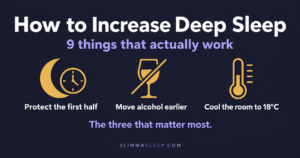
Protect the first half of your night
This is the most useful thing on the page, and it follows directly from how sleep works.
Your deep sleep is front-loaded. The first two cycles carry most of it. So what happens between 10pm and 1am matters far more than what happens between 4am and 7am.
👉 That reframes the whole problem. You’re not trying to sleep longer. You’re trying to protect a specific window.
Practically: whatever you’re doing that disrupts those early hours — the late drink, the late meal, the late scroll — is costing you disproportionately. Fix that window and you fix most of it.
Move alcohol earlier, or skip it
If you drink in the evening, this is likely your biggest single lever.
You don’t have to quit. Just move it earlier. A drink at 6pm has largely cleared by bedtime. The same drink at 10pm sits right on top of your deep sleep window.
👉 Try a week with nothing after 7pm and see how the mornings feel. It’s the fastest experiment on this list.
Keep your bedtime roughly consistent
Not perfect. Consistent.
Same rough window every night, including weekends. Your body settles into a rhythm and starts preparing for sleep before you get there, which means the early cycles run properly instead of taking an hour to get going.
Get light early, cut it late
Ten minutes of daylight in the morning anchors your internal clock. Dimmer light in the evening lets it wind down on schedule.
Most people have this backwards — dark mornings indoors, bright screens at night. Flipping it is free and takes no willpower.
Cool the room down
Your core temperature has to drop for deep sleep to happen. A warm bedroom physically blocks it.
Cooler than feels immediately comfortable is usually about right. This is the easiest fix on the list and the one people most often overlook.
Cut caffeine off by early afternoon
Not because it stops you sleeping — because it shallows the sleep you get. Early afternoon is a reasonable cutoff for most people.
Give your brain somewhere to put tomorrow
If your mind races the moment you lie down, that’s usually unprocessed thinking looking for somewhere to go.
Writing tomorrow’s list down before bed sounds trivial. It works because it gives those thoughts a destination other than your pillow.
What to skip
Where supplements fit
After the above, not before it. Everything on this list costs nothing and addresses the actual causes for most people — anything you take on top of poor timing, evening alcohol and a warm bedroom is working uphill.
If you’ve genuinely done the basics for a month and age-related decline looks like your issue, that’s a reasonable point to look at what else might help. As support, not a shortcut.
When It’s Something Else
Here’s the part most articles on this topic leave out.
Sometimes the answer to why do I wake up tired after 8 hours sleep isn’t a habits problem at all. And no amount of adjusting your bedtime will fix something that needs actual medical attention.
If you’ve genuinely worked through the basics — consistent timing, no late alcohol, cool room, sensible caffeine — and you’re still waking up exhausted after eight hours, it’s worth getting checked properly.
Sleep apnea
The most common culprit, and the most commonly missed.
Sleep apnea causes your breathing to repeatedly stop and restart through the night. Each interruption pulls you briefly out of deep sleep. It can happen dozens or hundreds of times, and you won’t remember a single one.
👉 That’s what makes it so easy to miss. From your side, you slept eight hours. From your body’s side, you were dragged out of deep sleep all night long.
Worth investigating if you snore heavily, wake with a dry mouth or headache, or if a partner has ever mentioned you stop breathing or gasp in your sleep.
Thyroid, iron and vitamin levels
An underactive thyroid causes persistent fatigue that sleep doesn’t resolve. So does iron deficiency, and low vitamin D or B12. All are common, all are straightforward blood tests, and all are treatable once identified.
This group disproportionately affects women, and it’s frequently written off as “just being tired” for years before anyone checks.
Depression and anxiety
Both affect sleep architecture directly and both cause fatigue that rest doesn’t fix. If low mood, loss of interest, or persistent anxiety are part of your picture alongside the tiredness, that’s worth raising with a doctor.
Medication side effects
Plenty of common medications affect sleep quality — some blood pressure medications, antidepressants, antihistamines and others. If your tiredness began around the time a prescription started, that’s a conversation with whoever prescribed it, not a reason to stop taking it.
When to actually go
⚠️ Book an appointment if any of these apply.
You’ve fixed the obvious things and nothing changed after a month. Someone has told you that you stop breathing or gasp during sleep. You fall asleep during the day without meaning to — while sitting, reading, or worse, driving. The exhaustion is affecting your work, your mood, or your relationships. Or it came on suddenly with no obvious cause.
👉 None of that means something is seriously wrong. Most of it turns out to be straightforward and treatable. But it does mean the answer isn’t in a blog post — including this one.
I’d rather tell you that than pretend better sleep hygiene fixes everything. It doesn’t, and for some people reading this, the most useful thing on this page is the suggestion to go and get a blood test.
The Bottom Line
If you’ve been asking why do I wake up tired after 8 hours sleep, here’s the answer in one line.
You probably didn’t get eight hours of sleep. You got eight hours in bed, and inside that, not enough of the stage that actually restores you.
Deep sleep is what determines how you feel in the morning. It’s front-loaded into the first half of your night, it declines naturally as you get older, and it’s easily disrupted by things that don’t feel like sleep problems at all — an evening drink, a warm room, an inconsistent bedtime.
👉 That’s why “just sleep more” never worked. More hours of shallow sleep doesn’t produce what your body was missing.
Where to start
Protect the first half of your night. That’s the window that matters most, and most of what steals your deep sleep happens in it.
Move alcohol earlier. Keep your bedtime roughly consistent. Cool the room down. Get light in the morning, less of it at night.
None of that costs anything, and for most people it’s where the answer actually is.
And if you’ve done all of it properly for a month and you’re still exhausted — that’s your signal to get checked rather than to try harder. Sometimes tiredness is a medical question, and the useful move is finding out.
One last thing
You’re not lazy and you’re not imagining it. Waking up exhausted after a full night is a real, physical thing with real, identifiable causes.
The good news is that most of those causes are fixable, and you don’t need to fix them all at once.
💡 Want to go deeper?
Poor sleep quality doesn’t just leave you tired — it shifts the signals that control hunger, stress and how your body stores fat. Most people have no idea which of those is affecting them most.
👉 I’ve broken all three down in plain language in a free guide: The 3 Hormones Secretly Blocking Your Belly Fat Loss.
Pick one thing from this page and change it this week — the drink, the bedtime, the thermostat. See how the mornings feel by the weekend. Every little helps.