You get through the whole day fine.
Breakfast, lunch, a reasonable dinner. No real struggle, no white-knuckling. Then somewhere around eight or nine o’clock the kitchen starts calling, and suddenly you’re standing in front of a cupboard you had no intention of opening.
👉 Same person. Same willpower. Twelve hours apart.
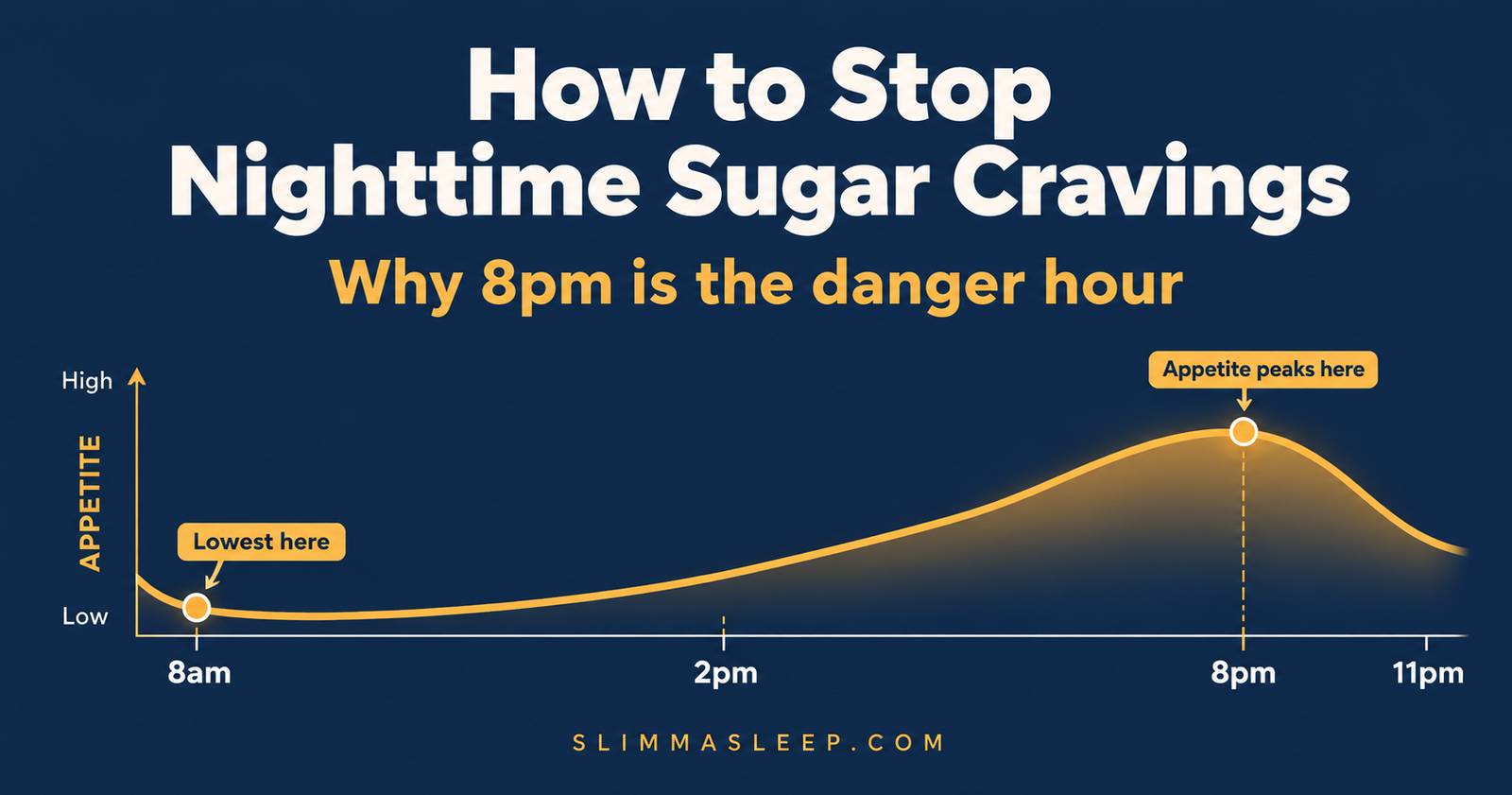
If you’ve been searching for how to stop nighttime sugar cravings, this is the part that changes things: the pattern isn’t a character flaw, and it isn’t random. Researchers who tracked hunger around the clock found it peaks at roughly 8pm and bottoms out at 8am — driven by your body clock rather than anything you ate or did that day.
Your appetite is genuinely higher in the evening. And it’s pulling specifically toward sweet, starchy food.
⚠️ Which explains why willpower keeps failing you at exactly that hour. You’re not fighting a bad habit. You’re fighting a biological rhythm, and it’s older than you are.
The good news is that the rhythm is only part of the story. There are four things that turn a normal evening appetite into a craving you can’t ignore — and all four are fixable.
This post covers why 8pm is the danger hour, what makes it worse, and six changes that work on the conditions rather than asking you to want it less.
Let’s start with what’s actually happening.
This post contains affiliate links. If you purchase through our links we may earn a commission at no extra cost to you. Read our Affiliate Disclosure.
Table of Contents
Why 8pm Specifically
If you’ve ever wondered why do I crave sugar at night when I’m fine all day, here’s the answer: the timing isn’t random, and it isn’t about your day.
Researchers at Harvard put twelve healthy adults in a controlled laboratory for thirteen days, monitoring exactly when they ate and slept. They found participants felt most hungry around 8pm and least hungry around 8am — and crucially, this happened independently of their meals, their activity, or anything they’d done that day.
👉 It was the body clock doing it.
The same study found the pattern held specifically for sweet, starchy and salty foods. Your circadian system doesn’t just make you hungrier in the evening — it makes you hungrier for exactly the things you’re trying to avoid.
Why your body works this way
The explanation is older than your kitchen.
For most of human history, food was unreliable and the night ahead meant eight or more hours without eating. A built-in evening drive to eat more — particularly calorie-dense food — was useful. It got you through the fast.
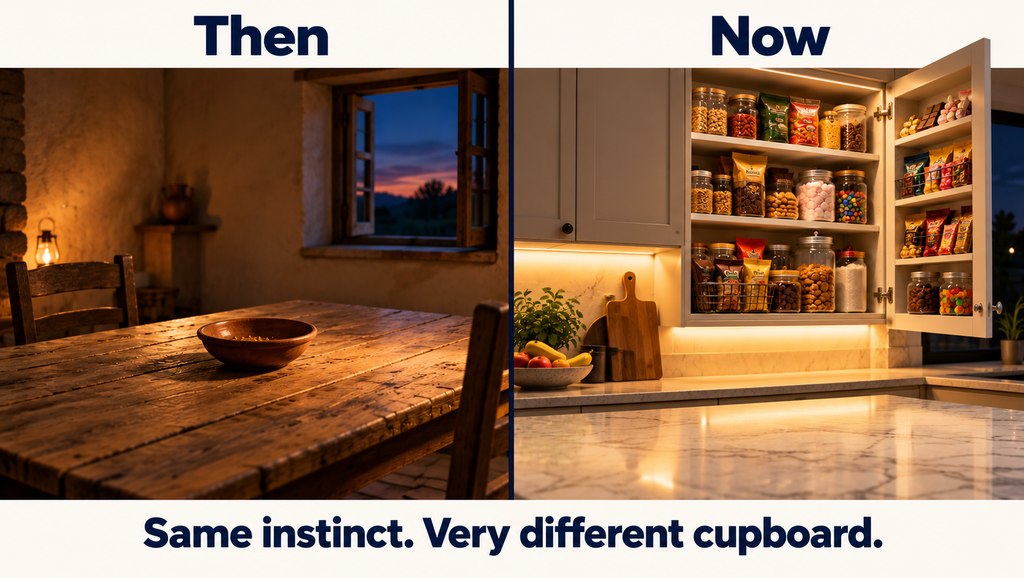
That instinct hasn’t updated. It just now points at a cupboard containing biscuits rather than a scarcity problem.
What this changes
If you’ve been treating nighttime cravings as a discipline failure, this is the reframe.
You’re not weak at 9pm and strong at 9am. Your baseline hunger is genuinely higher in the evening, and it’s pulling specifically toward sugar. Same person, same willpower, different biological conditions.
⚠️ That doesn’t mean you’re powerless. It means the fixes that work aren’t the ones you’ve been trying.
That’s why how to stop nighttime sugar cravings is the wrong question when it’s framed as willpower. Fighting a hardwired evening appetite head-on is a losing position. Changing the conditions around it isn’t.
👉 Which is what the rest of this post covers — but first, the four things that turn a normal evening appetite into a craving you can’t ignore.
Four Things That Make It Worse
A built-in evening appetite is normal. What turns it into late night cravings you can’t ignore is usually one of these — and most people have at least two running.
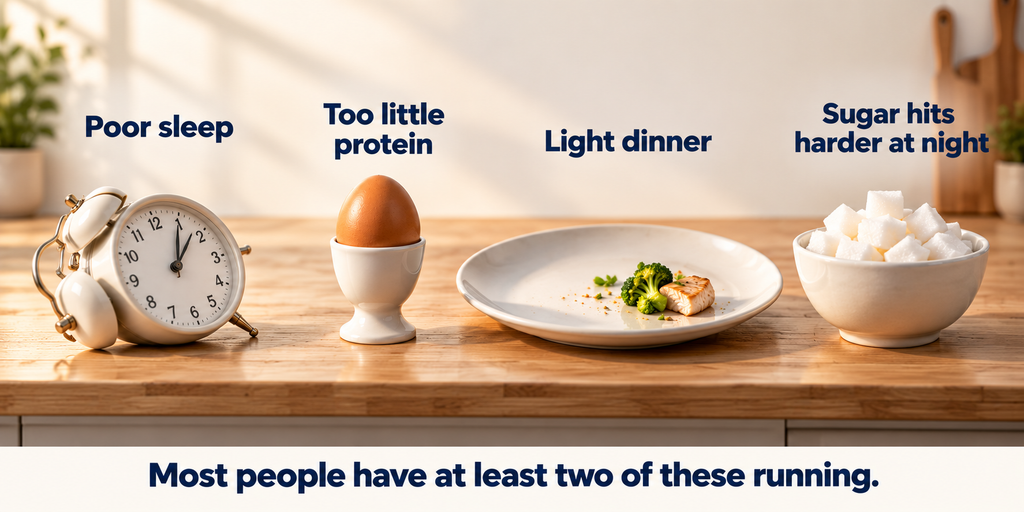
You didn’t sleep well
Short or broken sleep raises your hunger signalling the following day and increases the pull toward high-sugar, high-fat food specifically.
👉 So a bad night on Tuesday shows up as a 9pm raid on the cupboard on Wednesday. The two feel unconnected. They aren’t.
⚠️ And it compounds. Sugar late in the evening disrupts sleep, which raises cravings the next day. Round it goes.
You under-ate protein earlier in the day
This is the most common one and the easiest to miss.
If your brain hasn’t received a strong enough protein signal across the day, it pushes harder for fast, high-reward calories later. Toast for breakfast, a sandwich at lunch, then wondering why you’re ransacking the kitchen at nine.
Your dinner wasn’t substantial enough
A carb-heavy, low-fibre, low-protein dinner produces a glucose rise followed by a dip a couple of hours later.
👉 That dip lands at roughly 9 or 10pm — exactly when your circadian appetite is already peaking. Two forces arriving at the same moment.
Your body handles sugar worse at night anyway
Insulin sensitivity drops in the evening. The same biscuit produces a sharper spike and a steeper crash than it would at breakfast.
That crash then triggers a second trip to the kitchen, which is why one biscuit so rarely stays one biscuit.
Four things, and none of them is about wanting it badly enough. Which is why knowing how to stop nighttime sugar cravings starts with the conditions, not the craving.
👉 Which is why the fixes below target the conditions rather than the craving.
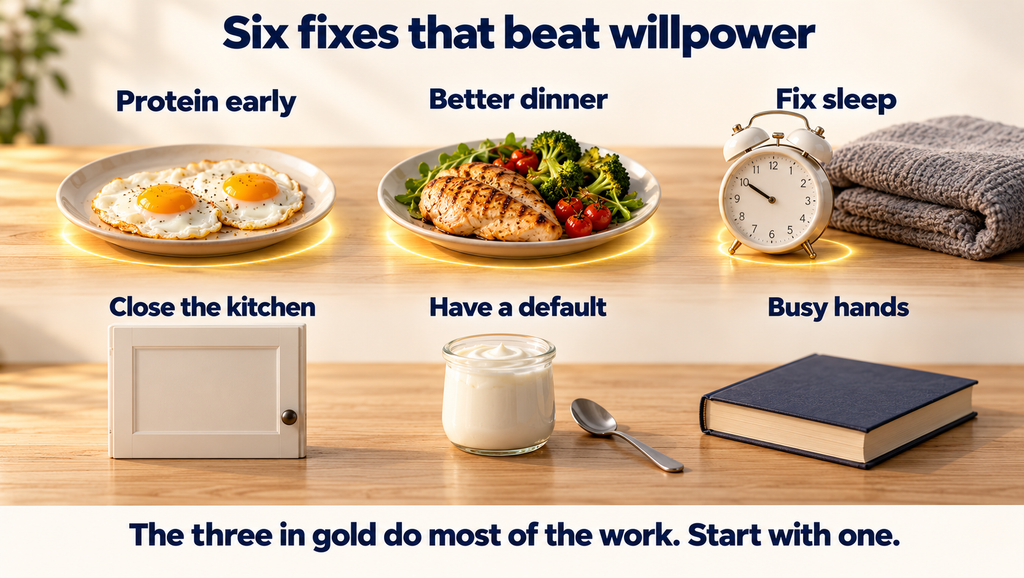
1. Front-Load Your Protein
The single most effective change, and it happens twelve hours before the craving does.
If your brain gets a decent protein signal early in the day, it stops pushing so hard for fast calories later. Most people’s intake is backloaded — minimal at breakfast, moderate at lunch, most of it at dinner. That’s exactly backwards for craving control.
👉 Get a solid portion of protein into breakfast. Eggs, Greek yoghurt, leftover meat from last night — the specific source matters far less than it being there at all.
⚠️ If breakfast is currently toast, cereal or nothing, this one change will do more than the other five combined.
2. Make Dinner Actually Substantial
If you’re craving sweets after dinner most evenings, start here. A light dinner feels virtuous and reliably backfires.
What you want is protein, fibre and some fat together. That combination blunts the glucose curve so you don’t get the dip two hours later that collides with your evening appetite peak.
👉 Practically: if your dinner is mostly pasta, rice or bread with a small amount of protein, flip the proportions. More of the protein and vegetables, less of the starch.
Not a smaller dinner. A better-balanced one. Eating less at 7pm to “save calories” usually costs you more at 10.
3. Fix Your Sleep First
If you’re sleeping badly, every other approach to how to stop nighttime sugar cravings works uphill.
Poor sleep raises appetite signalling and increases the pull toward sugar specifically. You can do everything else right and still lose to a 9pm craving if you’ve had four bad nights in a row.
👉 The highest-value changes are protecting the first half of your night, moving alcohol earlier, and getting the bedroom genuinely cold. We’ve covered the full picture in how to increase deep sleep.
And if you’ve already done the basics and still wake unrefreshed, our Resurge review looks at a formula built around deep sleep — including where its marketing overreaches.
4. Close the Kitchen (The Simplest Way to Stop Nighttime Sugar Cravings)
A deliberate end point does more than willpower, because it removes the decision rather than asking you to win it repeatedly.
Pick a time — say 8:30 — and after that the kitchen is shut. Lights off, dishwasher on, done for the night.
👉 The power is in the rule being decided in advance. You’re not standing in front of the cupboard at 9:45 negotiating with yourself. You settled it hours ago when you weren’t hungry.
⚠️ It takes about a fortnight to stop feeling arbitrary. After that it mostly runs itself.
5. Have a Default Ready
Sometimes you’re genuinely hungry rather than just craving, and willpower-only plans fall apart the first time that happens.
Decide now what the answer is, so you’re not choosing in the moment. A small Greek yoghurt. A piece of fruit with some nuts. A mug of herbal tea if it’s habit rather than hunger.
👉 The point isn’t that these stop nighttime sugar cravings on their own. It’s that a decided default beats an open question when your resolve is at its lowest and your appetite is at its peak.
And keep the thing you reach for most at eye level, with the biscuits somewhere genuinely inconvenient. Friction works.
6. Give Your Evening Something to Do
A lot of nighttime eating isn’t hunger at all. It’s the first unstructured hour of the day meeting a hand that wants something to do.
You sit down, the distractions stop, and eating becomes the available activity.
👉 Anything occupying your hands works better than deciding not to eat. A walk after dinner, something you’re building or reading, even a jigsaw. It sounds trivial and it genuinely interrupts the pattern.
⚠️ Scrolling doesn’t count. One hand free is one hand reaching.
The Bottom Line
Your appetite peaks around 8pm and bottoms out at 8am. That’s your body clock, not your character — and it’s been running that way since long before biscuits existed.
👉 Which means how to stop nighttime sugar cravings was never a willpower question — and willpower was never the fix.
If you only do two things
Get real protein into your breakfast, and make dinner properly substantial rather than virtuously small. Those two address the conditions that turn a normal evening appetite into something you can’t ignore.
Everything else on this list helps. But if you only remember one thing about how to stop nighttime sugar cravings, it’s those two.
⚠️ And if you’re sleeping badly, start there instead. Four bad nights will beat any amount of good planning.
Don’t try all six
Pick one. Hold it for a fortnight and see whether your evenings feel different.
👉 The goal isn’t to never want something sweet at 9pm. You probably always will — that part’s hardwired. The goal is for it to be a passing thought rather than something that wins.
💡 Want to understand the bigger picture?
The signals driving hunger, cravings and fat storage are mostly set by three hormones — and most people have no idea which one is working against them hardest.
👉 I’ve broken all three down in plain language in a free guide: The 3 Hormones Secretly Blocking Your Belly Fat Loss.
If you want to know how to stop nighttime sugar cravings for good, start with breakfast tomorrow. It’s the earliest point in the chain and the easiest thing to change. Every little helps.