Something changed. You know it did.
Same food, roughly the same habits, and somewhere in your forties the results stopped matching the effort. Weight settles differently now. The things that used to work don’t.
Search how to boost metabolism after 40 and you’ll get the same explanation everywhere: your metabolism slowed down.
👉 It didn’t.
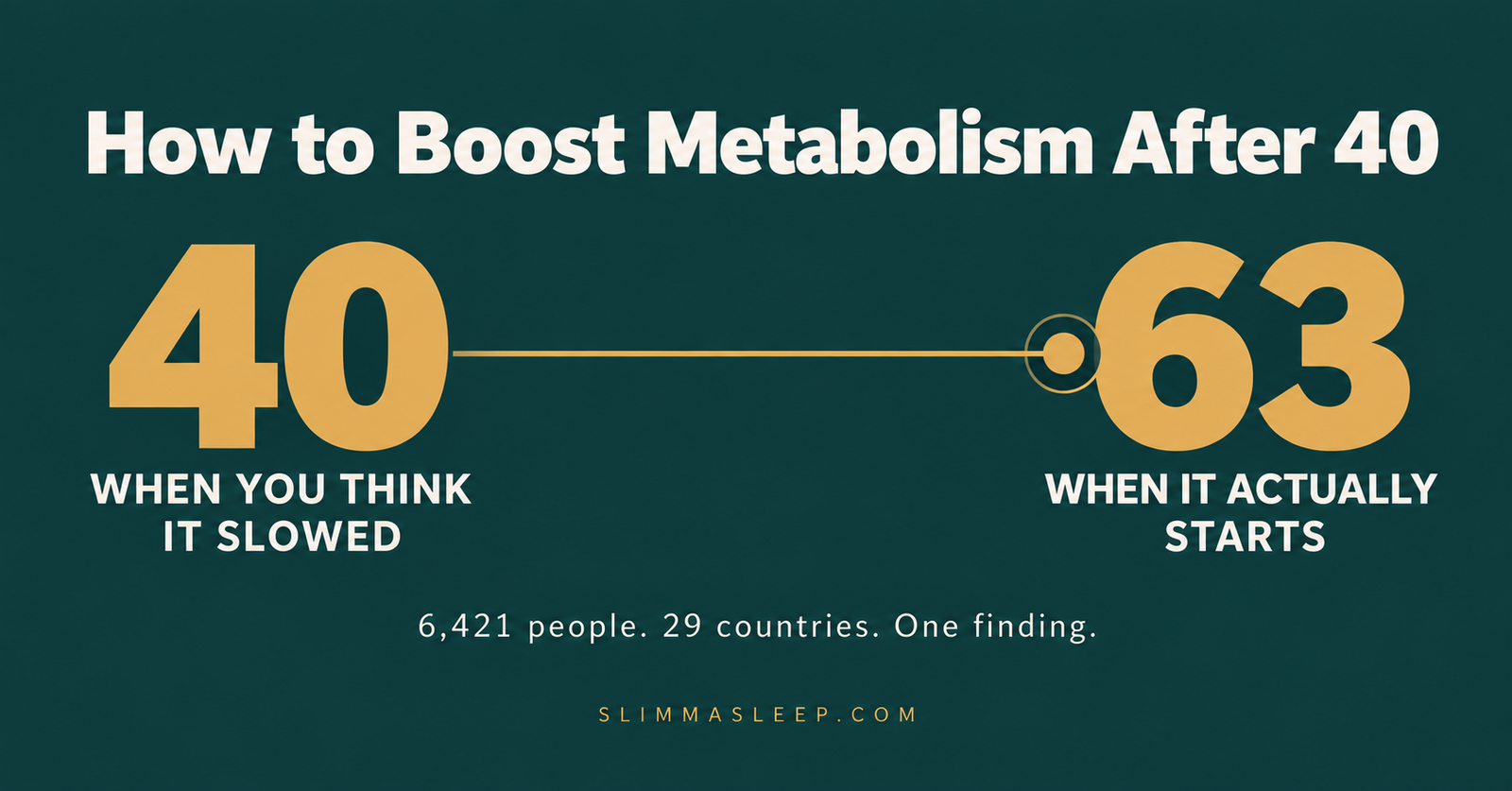
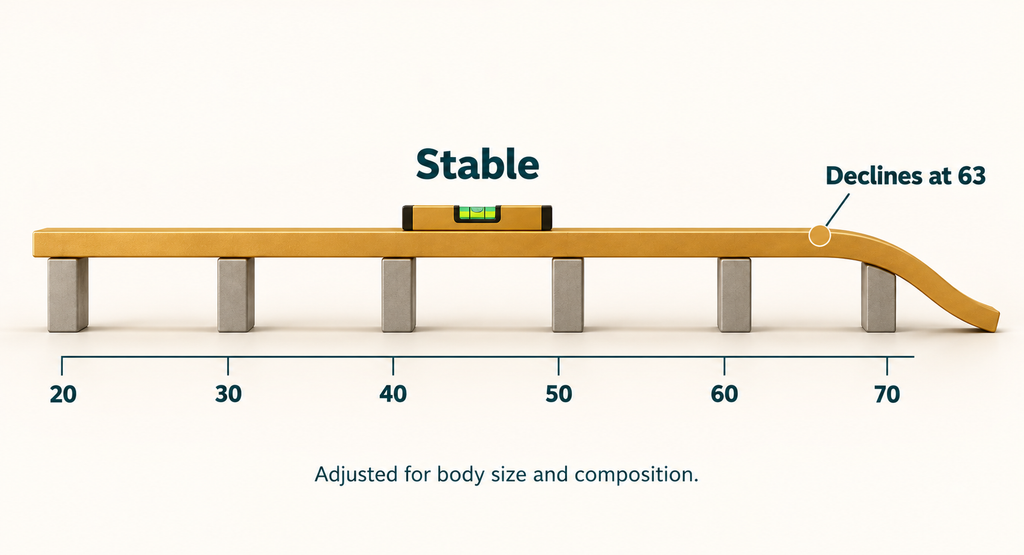
The largest study ever conducted on human energy expenditure — over 6,400 people across 29 countries — found that metabolic rate stays stable from age 20 all the way to 60. The decline doesn’t begin until around 63, and even then it’s under 1% a year.
Your metabolism at 45 is, adjusted for your body, essentially what it was at 25.
⚠️ Which raises the obvious question. If it isn’t your metabolism, what actually changed?
Three things did, and two of them are entirely fixable. But you won’t find them by eating less or buying something that promises to fire up your metabolism — because neither is aimed at the real problem.
This post covers what the research actually shows, the three things that genuinely changed between 25 and 45, and what works when you stop chasing the wrong explanation.
Let’s start with the finding that reframes all of it.
This post contains affiliate links. If you purchase through our links we may earn a commission at no extra cost to you. Read our Affiliate Disclosure.
Table of Contents
Your Metabolism Didn’t Slow Down
Let’s start with the thing that makes this post different from almost everything else you’ll read on the subject.
In 2021, researchers published the largest study ever done on human energy expenditure — 6,421 people across 29 countries, aged from eight days old to 95, measured using the gold-standard method rather than estimates.
So does metabolism slow with age? They found something that contradicts almost everything you’ve been told.
👉 Metabolic rate is stable from age 20 to 60. Not declining gradually. Stable.
The decline doesn’t begin until around 60, and when it does it’s less than 1% a year. The statistical break point sits at age 63.
What that means in practice
Your metabolism at 45 is, adjusted for body size and composition, essentially what it was at 25.
Not slightly lower. Not “a bit sluggish.” The same.
⚠️ The study also found this held true through pregnancy, and that there was no difference between men and women of similar body and muscle size. Which means the question of how to boost metabolism after menopause has a simpler answer than most articles suggest — there’s no menopause-specific metabolic decline to reverse.
Why this matters more than it sounds
If you’ve spent the last few years assuming your body turned against you at 40, that assumption has been shaping your decisions. It’s why people cut calories harder, buy metabolism boosters, and conclude the problem is biological and therefore not really fixable.
👉 It isn’t biological. Or rather — it is, but not in the way you’ve been told.
Something genuinely did change between 25 and 45. The weight gain is real, the difficulty is real, and you’re not imagining that the same habits now produce a different result.
But metabolic rate isn’t the thing that changed. And knowing what actually did changes what you should do about it.
So What Actually Changed?
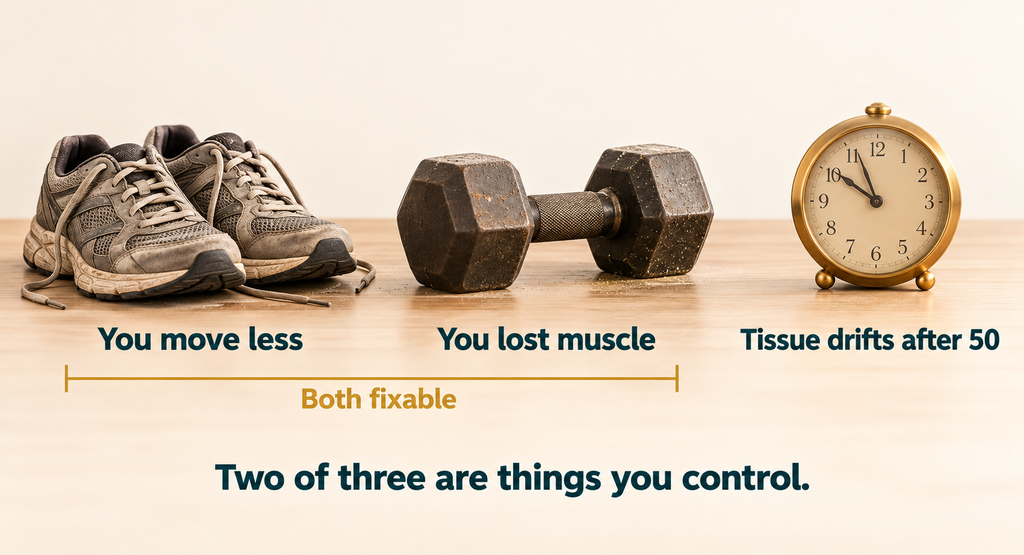
Three things changed, and how to boost metabolism after 40 depends on knowing which. Only one of them is biological, and it arrives later than you’d think.
You move less — and you haven’t noticed
For anyone asking how to boost metabolism after 40, this is the big one — and it’s almost invisible.
Not exercise. Everything else. Walking, standing, carrying things, taking stairs, fidgeting, pacing while on the phone. All the unconscious movement that fills a day.
👉 Compare a typical day at 25 with a typical day at 45. More desk time. More driving. A job with more responsibility and less moving about. Children, which paradoxically often means more sitting in cars and less walking anywhere.
None of it feels like a choice. Nobody decides to move less. But the cumulative difference across a day is substantial, and it’s the single largest and most controllable component of what you burn.
⚠️ Researchers describe activity energy expenditure as behavioural rather than biological. Which is the good news — behaviour is changeable in a way that metabolic rate isn’t.
You’ve lost muscle without replacing it
From your thirties onward, you lose muscle steadily unless something is asking you to keep it.
Muscle is metabolically active tissue — it burns energy around the clock, even at rest. Less muscle means a lower resting burn, and the loss happens gradually enough that you never notice a specific moment.
👉 This is real, and it does lower what you burn. But note what it isn’t: it isn’t your metabolic rate declining. It’s you carrying less of the tissue that does the burning.
Different problem, different solution.
Your tissue efficiency drifts — after about 50
The third factor is genuinely biological, and it’s the smallest.
After roughly 50, the metabolic rate of tissue itself begins to shift slightly. By 60 it’s measurable — which is why how to boost metabolism after 60 is a genuinely different question from this one. By your nineties, total expenditure runs around 26% below midlife.
⚠️ But at 42? Negligible. This isn’t what’s happening to you yet.
Put them together
Two behavioural factors and one biological one that hasn’t really kicked in yet.
👉 Which means most of what feels like a slower metabolism is actually less movement and less muscle — both of which respond to what you do.
Why It Feels Like Your Metabolism
If the metabolic rate didn’t change, why does every article on how to boost metabolism after 40 describe it that way?
Because from the inside, the two are indistinguishable.
The experience is identical
You eat roughly what you always ate. You’re about as active as you ever were — or you think you are. And the result is different.
Same inputs, different output. There’s only one obvious explanation for that, and it’s that something inside you changed.
👉 “My metabolism slowed down” is a reasonable conclusion from the evidence available to you. It’s just the wrong one.
Nobody can feel the actual cause
Here’s the problem. The two things that genuinely changed are both invisible from the inside.
You can’t feel a 3,000-step drop in daily movement. It happened gradually, across years, and each individual day felt normal. Nobody notices they’ve stopped taking the stairs.
And you certainly can’t feel muscle loss. There’s no sensation attached to carrying two kilos less lean tissue than you did a decade ago. The scale doesn’t even show it clearly, because fat replaced it.
⚠️ So the real causes are silent, and the wrong explanation is the only one that presents itself.
Why the myth is so persistent
It also gets repeated constantly — by articles, by supplement marketing, and by people around you saying the same thing about themselves.
👉 And it’s a comfortable explanation. If your metabolism betrayed you, none of this is your doing. That’s easier to sit with than the alternative.
But it’s also the version that leaves you stuck, because it points at something you can’t change instead of two things you can.
How to Boost Metabolism After 40: What Actually Works
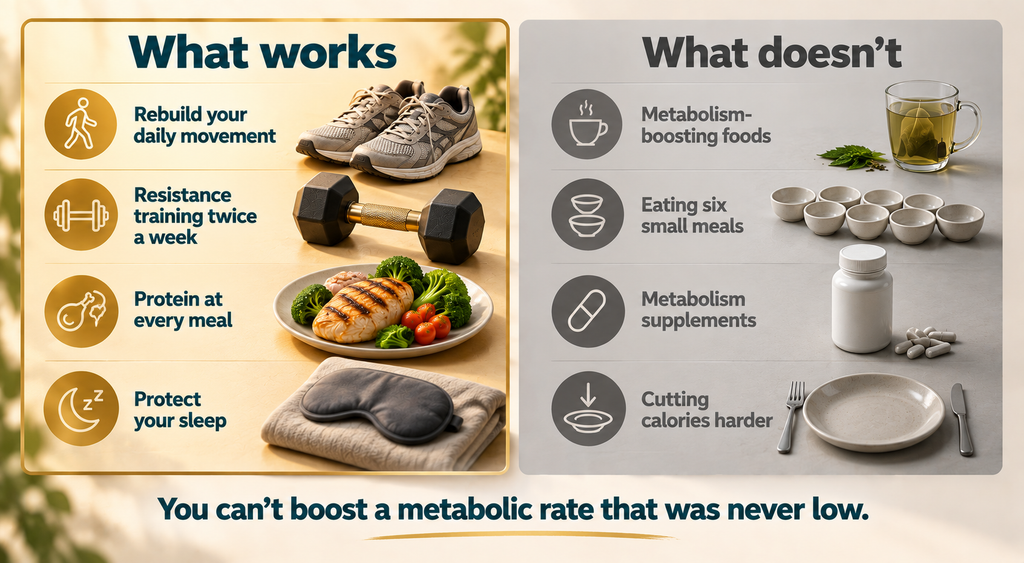
If the real changes are movement and muscle, that’s where the effort goes. Here’s what matters, ordered by impact.
Rebuild the movement you lost
The largest and most controllable factor, and it isn’t about exercise.
👉 Check your step count for a week — not to hit a target, but to see where you actually are. Most people in their forties are surprised. A drop from 9,000 a day to 5,000 is enormous across a year and completely invisible day to day.
Then set a floor rather than a goal. A minimum you don’t go below, including days when you’re busy or it’s raining. That stops the quiet drift.
Practically: a walk after dinner, parking further away, taking calls standing up, stairs by default. None of it feels like training. That’s the point — it needs to be sustainable enough to become automatic.
Protect and rebuild your muscle
The second real change, and the one with the clearest fix.
Resistance training two or three times a week is enough to stop the loss and start reversing it. Bodyweight, bands, dumbbells, machines — whichever you’ll actually do.
👉 You’re not training to burn calories during the session. You’re training to keep the tissue that burns energy around the clock.
⚠️ And if you’ve been doing cardio only, this is the gap. Cardio burns during the workout and does little to protect muscle. On a calorie deficit, cardio alone can actively cost you some.
Eat enough protein to support it
Muscle is built and maintained from protein, and your body becomes less efficient at using it as you age — so it matters more after 40, not less.
Most people trying to lose weight cut across the board and lose muscle in the process. Keeping protein high while in a deficit is what tells your body to hold onto it.
👉 Build meals around protein rather than treating it as a side. You don’t need to count grams; you need it present at every meal rather than mostly at dinner.
Don’t let sleep undermine the rest
Poor sleep raises appetite signalling, increases cravings, and reduces your unconscious daily movement — which is the exact thing you’re trying to rebuild.
👉 Protect the first half of your night, move alcohol earlier, keep the bedroom cold. We’ve covered the full picture in how to increase deep sleep.
And if you’ve done the basics for a couple of months and still wake unrefreshed, our Resurge review looks at a formula built around deep sleep — including where its marketing overreaches.
Be patient with the muscle part
How to boost metabolism after 40 takes patience here — rebuilding muscle is slow. You won’t see much in three weeks.
⚠️ But it’s the only one of these changes that compounds. Every bit you add raises your resting burn permanently, rather than for the duration of a workout.
What Doesn’t Work
Worth being straight about the things sold as answers to how to boost metabolism after 40 that mostly aren’t.
“Metabolism-boosting” foods
Green tea, chilli, ginger, cold water. All of these have a measurable thermogenic effect, and all of it is trivially small.
👉 You’d need to drink green tea all day to produce a difference you could detect on a scale. Enjoy them because you like them. Don’t count on them.
Eating six small meals a day
The idea that frequent eating “keeps your metabolism running” doesn’t hold up. Total intake matters; the number of sittings it arrives in doesn’t change your energy expenditure meaningfully.
⚠️ For some people it makes portion control harder, not easier.
Most metabolism supplements
This is a supplement review site, so let me be clear about it.
Nothing you take will raise a metabolic rate that was never low in the first place. If the Pontzer data is right — and it’s the largest study of its kind — your metabolic rate at 45 is normal. There’s nothing there to boost.
👉 What supplements in this space can plausibly do is support blood sugar, digestion, sleep or cravings. Those are real and sometimes useful. “Firing up a sluggish metabolism” is marketing language for a problem the research says most people under 60 don’t have.
Cutting calories harder
The instinctive response, and usually the wrong one.
An aggressive deficit costs you muscle, which lowers your resting burn, which makes the next attempt harder. You end up eating very little with nothing left to cut.
👉 We’ve covered why that backfires in why a calorie deficit sometimes stops working.
The Bottom Line
Your metabolism at 45 is essentially what it was at 25. The largest study ever done on human energy expenditure found it stable from 20 to 60, with the decline not starting until around 63.
👉 So how to boost metabolism after 40 starts by dropping the thing you’ve been blaming — it isn’t what changed.
What did change
You move less than you used to, and you didn’t notice it happening. And you’ve lost muscle that nothing was asking you to keep.
Both are real. Both lower what you burn. Neither is your metabolic rate.
⚠️ And both respond to what you do, which the version you’ve been told doesn’t.
Where to start
Check your step count this week. Not to fix it yet — just to see it. Most people are genuinely surprised by the number, and that surprise is usually the thing that makes the change stick.
Then add two short resistance sessions a week and get protein into every meal rather than mostly at dinner.
👉 That’s how to boost metabolism after 40 in practice. Movement and muscle. Everything else on this page is secondary to those two.
One last thing
If you’ve been carrying the idea that your body turned against you at 40, you can put it down.
Nothing failed. Your life got busier and more sedentary, and the muscle you weren’t using quietly left. That’s a far better problem to have, because it’s one you can actually do something about.
💡 Want to understand the rest of the picture?
Movement and muscle are the structural side. The other half is hormonal — three signals that quietly drive hunger, stress and fat storage, and most people have no idea which one is affecting them hardest.
👉 I’ve broken all three down in plain language in a free guide: The 3 Hormones Secretly Blocking Your Belly Fat Loss.
Start with the step count. It takes no effort and it tells you more than any article will. Every little helps.